
Meet Amit and his goal
Amit is 43. His wife is 37. They have two children, aged 12 and 6. Amit has about ₹8 crore saved and wants to stop depending on a salary.
He wants ₹2.5 lakh every month from his savings. Because prices rise, he wants that amount to go up by 5% every year. And it must keep coming until his wife turns 90 – that is 53 years from now.
On top of that, both children will go to college. We set aside ₹25 lakh per child in today’s money, growing at 10% a year (education costs rise faster than normal prices). That works out to about ₹44 lakh in year 7 and about ₹78 lakh in year 13 – ₹1.23 crore in total, paid out of the same pot of money.
The question is simple: which investments, in what mix, can carry this load for 53 years – even if markets crash along the way?
The withdrawals get big – much bigger than ₹2.5 lakh
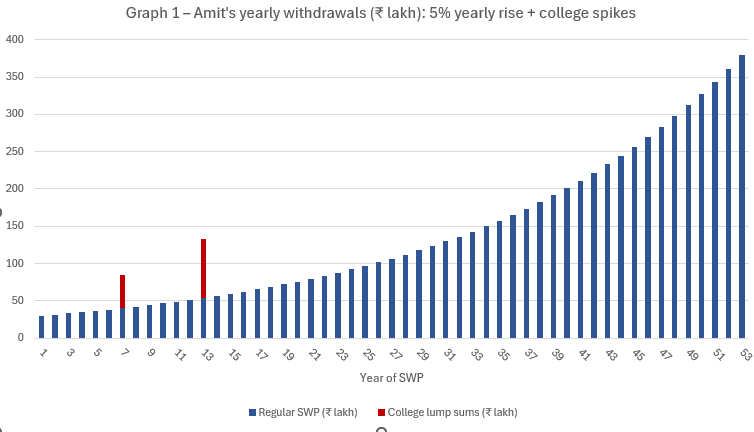
Rising 5% a year sounds small. But over 53 years it adds up. In year 1 Amit takes out ₹30 lakh (₹2.5 lakh × 12). By year 15 it is about ₹59 lakh a year. By the final year it is about ₹31.6 lakh every month. That sounds huge, but after 53 years of 6% inflation, ₹31.6 lakh a month buys about what ₹1.53 lakh buys today. So the plan is not generous – it simply keeps up with life. The two tall spikes in the graph below are the college years. They are the moments when the plan is most stretched, because a big chunk leaves at once.
The simple idea behind the plan: two buckets
Bucket 1 is a liquid fund (a very safe, cash-like mutual fund). It holds 12 months of withdrawals – ₹30 lakh to start. Every month, Amit’s ₹2.5 lakh comes from here. Nothing else.
Bucket 2 is the growth bucket. It holds everything else (₹7.7 crore) and does the long-term work. Once a year, Amit looks at the market. If the year was good, he sells a little from Bucket 2 to refill Bucket 1. If the year was bad, he does NOT sell – he lets Bucket 1 pay him while shares recover. Why bother? Because the biggest danger in any withdrawal plan is being forced to sell shares after they have crashed. Bucket 1 removes that pressure.
How much money is needed? It depends on the mix – and on crashes
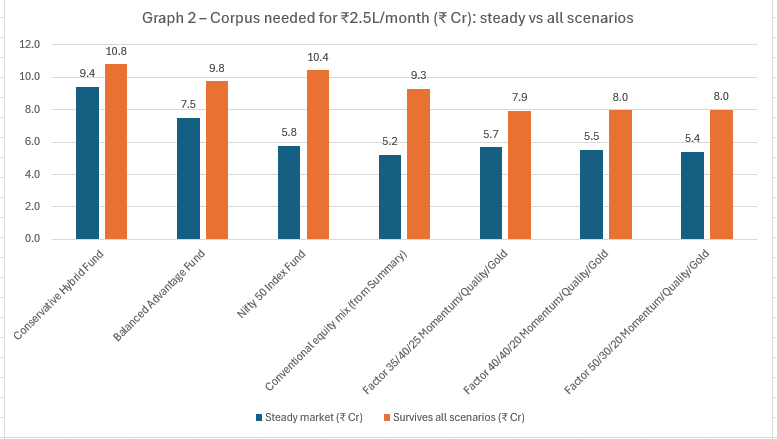
We tested seven different mixes for Bucket 2 against six market stories: a steady market, a crash in years 1-3, a crash in year 10, a lost decade, a choppy ±15% market, and a crash every 8 years.
For each mix we asked: how much money do you need today so the plan never runs dry?
We asked it twice – once for a steady market, and once for ‘safe on all six stories’.
Look at the gap between the two bars for each mix in Graph 2. The all-equity mixes (Nifty 50, the conventional equity mix) look cheap in a steady market – only ₹5.2-5.8 crore. But to survive every crash story they need ₹9.3-10.4 crore. This is the hidden cost of a bumpy ride when you are withdrawing every month. The factor mixes (Momentum + Quality + Gold) have the smallest gap. The 35/40/25 mix needs the least money to be safe on all stories: ₹7.91 crore.
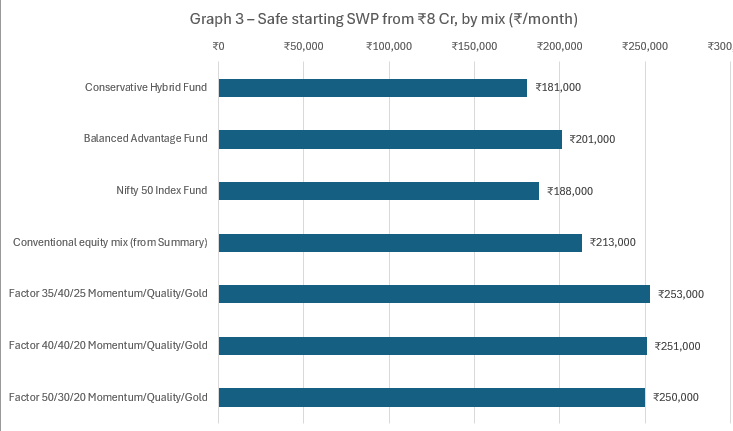
Another way to see it: with Amit’s actual ₹8 crore, how much can he safely start withdrawing? The 35/40/25 mix allows ₹2.53 lakh a month. A Conservative Hybrid fund – which sounds safer – allows only ₹1.81 lakh, because it grows too slowly for 53 years.
The mix that works
Bucket 1 – Liquid fund: ₹30 lakh (12 months of withdrawals). Expected return about 6.5%.
Bucket 2 – Momentum index fund (e.g. Nifty200 Momentum 30): 35% of the growth bucket, about ₹2.70 crore. Assumed return 14% – lower than its history, on purpose.
Bucket 2 – Quality index fund (e.g. Nifty200 Quality 30): 40%, about ₹3.08 crore. Assumed return 12.5%.
Bucket 2 – Gold ETF: 25%, about ₹1.93 crore. Assumed return 9%.
Blended expected return of the growth bucket: about 12.15% before tax.
Why these three? Momentum is the engine – it buys whatever has been rising. Quality is the steady hand – strong, low-debt companies that fall less. Gold is the shock absorber – it often rises when shares crash, which is exactly when Amit still needs his monthly cheque.
Stress test: what if momentum crashes like it did in 2008?
Momentum funds can fall very hard. In 2008 the momentum index fell about 68% while the Nifty fell about 52%. So we tested momentum falling 1.2×, 1.5× and 1.7× as hard as the market.
The result is clear in Graph 4: the more momentum you hold, the more money you need when stress rises. At severe stress, the 50/30/20 mix needs ₹9.71 crore, while 35/40/25 needs ₹8.70 crore. A defensive 30/45/25 needs ₹8.55 crore. Lesson: keep momentum at 35% or less of the growth bucket. It is a great engine, but a heavy one in a crash.
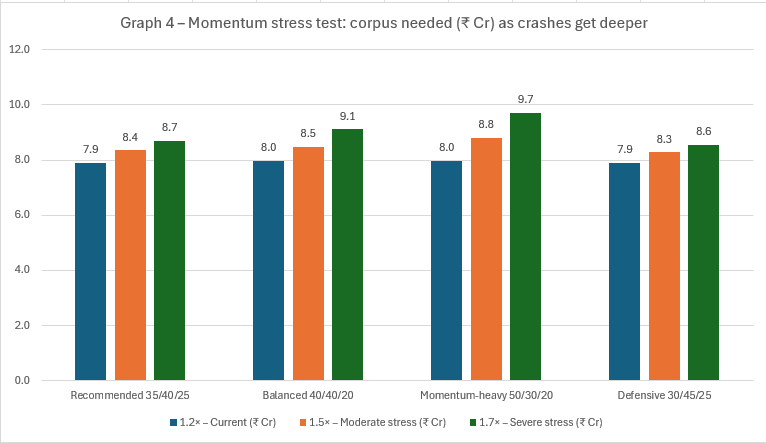
Because of this test, our honest view is: start at about ₹2.4 lakh a month instead of ₹2.5 lakh, OR build the corpus to about ₹8.36 crore before starting at ₹2.5 lakh.
Why not add a debt fund?
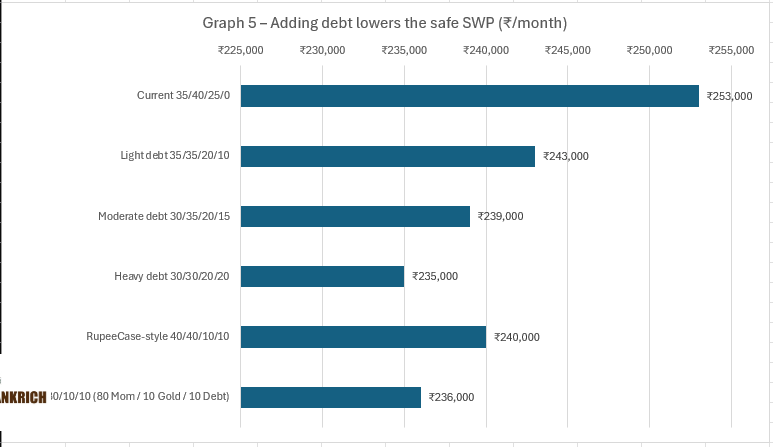
Many people would add a debt fund for safety. We tested five debt versions, including a popular 80/10/10 idea (80% momentum, 10% gold, 10% debt). Every single one paid less. Adding 10-20% debt cut the safe monthly withdrawal by ₹10,000 to ₹18,000 a month.
The reason is simple: debt earns about 7% and does not rise in a crash. Gold earns a bit more over time and often rises in a crash. And Bucket 1 (the liquid fund) already does the ‘safe money’ job. A second safe bucket just slows growth.
Why not the Value factor?
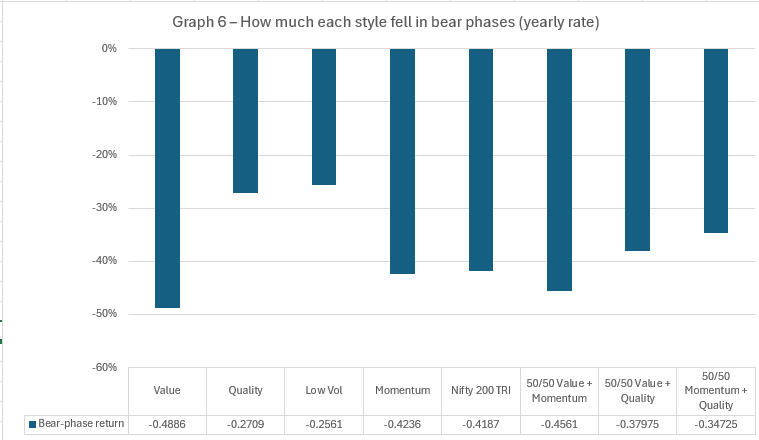
Value funds (cheap stocks) have a strong 20-year history. So we tested them too. But look at how each style did in bear markets (2010-2025 data): Value fell 48.9% a year in bear phases – the worst of all. Momentum fell 42.4%. Quality fell only 27.1%.
Pairing Value with Momentum means doubling up on crash risk. That 50/50 blend fell 45.6% in bear phases, compared with 34.7% for Momentum + Quality.
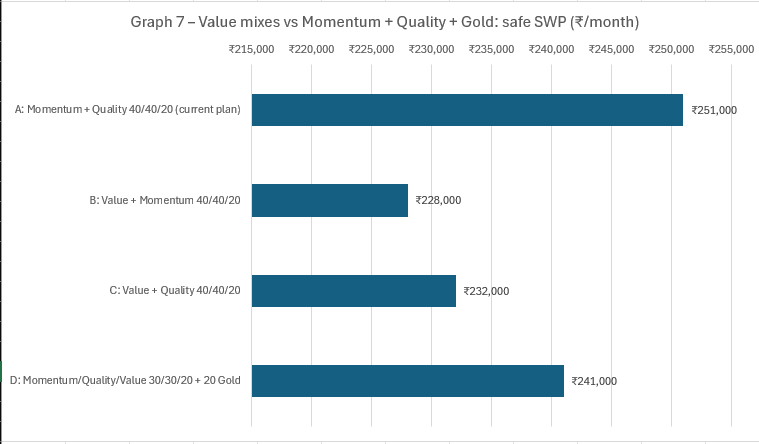
When we put Value mixes into Amit’s plan (all with 20% Gold), every one allowed a lower safe withdrawal than Momentum + Quality + Gold 40/40/20: ₹2.28 to ₹2.41 lakh a month vs ₹2.51 lakh. Also, Value 30 index funds only launched in 2024, and the index is about 75% banks, oil & gas, metals and power – a very cyclical group.
35/40/25 or 40/40/20?
Both are good. 40/40/20 does slightly better in a normal market (it could start at ₹3.72 lakh vs ₹3.61 lakh a month). But 35/40/25 holds up better in a crash (₹8.70 crore needed at severe stress vs ₹9.12 crore). Amit takes money out every single month, so a crash hurts him more than slightly slower growth. That is why we prefer 35/40/25.
What to do in a bad year
Step 1 – Don’t panic-sell. Keep paying from Bucket 1 and skip that year’s refill.
Step 2 – If Bucket 1 runs low, sell Gold first. It usually rises when shares fall.
Step 3 – Next, sell Quality. It falls less than Momentum.
Step 4 – Skip that year’s 5% increase. If the total is well below plan, cut withdrawals by 10-15% for a while.
Step 5 – Sell Momentum last. It is usually the most beaten-down and bounces back hardest.
Step 6 – When markets recover, refill Bucket 1 and rebalance back to 35/40/25.
A once-a-year checklist
Pick one month a year. Refill Bucket 1 if markets were up, then rebalance to 35/40/25. Don’t react to monthly news.
Review trigger: if the total falls below 75% of the starting value (₹6 crore), pause the 5% increase and re-plan.
Hold growth funds for at least 12 months before selling, so gains are taxed as long-term (12.5%).
What we deliberately ignored
Back-tests promising 18-38% a year. These come from short periods, ignore tax and costs, and are often fitted to the past. We used 14% for Momentum, 12.5% for Quality and 9% for Gold – below their history.
Monthly trend-switching (jumping to cash when a trend breaks). It triggers tax and exit loads and gets whipsawed in choppy markets. A simple once-a-year rebalance did better in our tests.
The summary in five lines
₹2.5 lakh a month rising 5% for 53 years, plus ₹1.23 crore of college, is a heavy load for ₹8 crore – possible, but only just.
Keep 12 months of withdrawals in a liquid fund so you never sell shares in a crash. 3. Invest the rest 35% Momentum / 40% Quality / 25% Gold. It needs the least money to survive every crash story we tested.
Skip debt and Value funds in the growth bucket – both lowered the safe payout.
Start at about ₹2.4 lakh a month (or build to ~₹8.36 crore for ₹2.5 lakh), and follow the bad-year steps without emotion.
Note if this overwhelming , which it will be as it is very difficult to be rationale when money is involved document it in a written plan and let execution be handled by someone who has done for a lot of people
Disclaimer: This is an educational illustration based on assumed returns and made-up market scenarios. It is not a guarantee and not personal investment advice. Past returns do not predict future returns. Please confirm fund choices and tax with a SEBI-registered investment adviser.
A lot goes into producing content like this, consider becoming a free or paid subscriber