
There is a meeting that happens every week in villages and slum clusters across 721 districts of India.
Twenty or so women sit on a mat. A field officer in a company shirt arrives on a motorcycle. Each woman hands over ₹300, or ₹500, or ₹1,200. The officer marks a register, the group signs off, and everyone goes back to work. Nobody has pledged gold. Nobody has mortgaged land. The only collateral in the room is that these women have to live next to each other for the rest of their lives.
That is the entire technology of microfinance. Not algorithms, reputation, and the Tuesday morning meeting.
Sometime in 2024, in large parts of India, that meeting stopped happening.
The consequences ran to roughly ₹55,000 crore of bad loans by March 2025 — about 14.8% of the industry’s gross loan book, per MFIN’s own data. Two years of contraction followed. Yet outside the sector, in an equity market busy arguing about defence stocks and PSU rallies, it barely registered.
Now the numbers have turned. So the question worth sitting with: are the green shoots real, or is this the same optimism that got everybody into trouble the last time?
Let me try to answer that properly, because the answer is more interesting than a yes or a no.
Part 1: How the fire started
In March 2022, the RBI did something quietly liberating. It scrapped the interest rate cap on NBFC-MFIs and replaced the old rules with a household-income and indebtedness framework. Lend to whoever you can assess, price for the risk you’re taking, just don’t let a household’s loan repayments cross half its income.
It was good regulation. It was also a starting gun.
Capital poured in. Fintechs and ordinary NBFCs, who weren’t classified as MFIs at all and therefore weren’t counted the same way in the industry’s own overlap data, started writing small unsecured loans to the same households. Ticket sizes crept up. The industry grew its book 29% in FY24.
And underneath the growth, three things rotted quietly.
One: the borrower collected lenders. The share of microfinance borrowers dealing with five or more lenders rose to 5.36% by December 2024, from 3.6% in September 2021. That understates it, because bureau reporting lagged and non-MFI unsecured loans often didn’t show up in an MFI’s overlap check at all. A woman could be repaying four institutions and none of the four could see the other three cleanly.
Two: the group stopped guaranteeing anything. As ticket sizes rose and field officers churned, centre meetings thinned out. Officers began collecting door to door because it was faster. The joint liability group the actual credit enhancement in the model became a formality on paper. What was left was unsecured lending at 20–24% with no security and no social pressure.
Three: nobody had ever tested it. The book had grown through a benign patch. There had been no serious income shock since COVID.
Then 2024 delivered one.
Part 2: The break — four shocks in twelve months
Shock one, mid-2024: income. A brutal heatwave, floods in parts of the east, and a general election that pulled field staff and borrowers away from the weekly rhythm. Collections dipped. In a book where the borrower is servicing four lenders out of one income stream, a small dip is not small.
Shock two, August 2024: the guardrails. MFIN, the sector’s self-regulatory body, tightened lending norms — capping lenders per borrower and household indebtedness. In January 2025 came Guardrails 2.0, effective 1 April 2025: a maximum of three lenders per borrower, a ₹2 lakh household indebtedness ceiling now inclusive of unsecured retail loans, and no fresh disbursement to anyone more than 60 days overdue on any loan above ₹3,000.
This was the right medicine and it hurt exactly the way right medicine does. A borrower who had been rolling loan four to repay loan one was now cut off. Rejection rates jumped. Loan originations in Q3FY25 fell 41.7% year-on-year by volume. The music stopped.
Shock three, February 2025: Karnataka. Following a spate of borrower suicides and complaints of coercive recovery, Karnataka promulgated an ordinance carrying jail terms of up to ten years and ₹5 lakh fines. RBI-regulated lenders were formally exempt. It made almost no difference in the field. Word spread that microfinance recovery was now a criminal matter, and collection efficiency for regulated lenders in the state fell below 90%. Karnataka held around ₹60,000 crore of the industry’s book. Tamil Nadu another ₹50,583 crore, roughly 13% of the national portfolio passed its own version, notified in June 2025.
This is the part outsiders underestimate. Microfinance is not just a credit business. It is a business whose only collateral is a social contract, and a state government can dissolve that contract in a single press conference.
Shock four: the arithmetic. Everything above showed up in the P&L in FY25 and FY26.
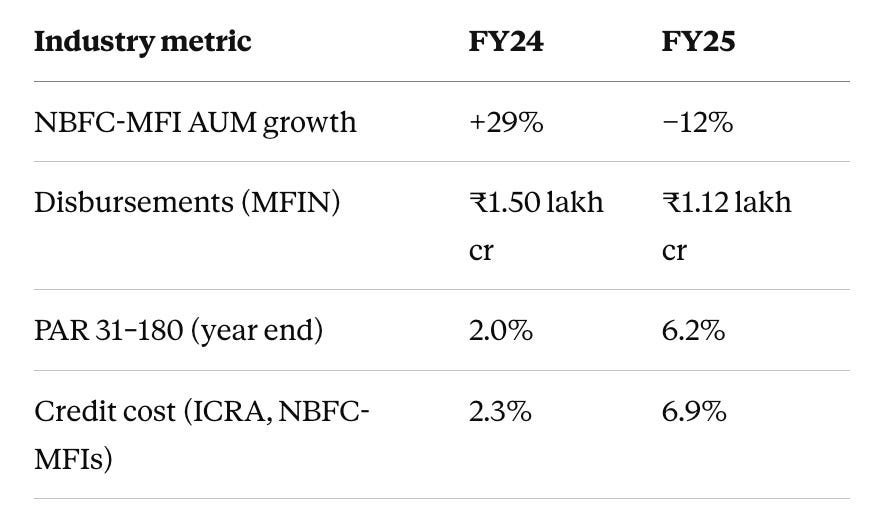
CareEdge’s reconstruction of what happened to the loan book that existed in March 2024 is the number that should stay with you: 14.1% of it was written off during FY25, another 3.6% sold to ARCs, 5.4% sitting in Stage 3, 3.4% in Stage 2. By the end of FY26, they estimate total stress touched roughly 30% of the March-2024 book.
Nearly one rupee in three of the pre-crisis loan book went bad.
And the human number, the count of borrowers with a loan outstanding from an NBFC-MFI stood at 3.4 crore in March 2026 down 15.8% in a single year. CreditAccess alone wrote off around 19 lakh borrowers between FY21 and FY26. Those women simply fell out of formal credit.
Part 3: One slide, one whole cycle
The CreditAccess Grameen slide is worth reading slowly, because it is the cleanest picture of a credit cycle you will find in an Indian investor deck. They even label the three phases themselves: Prioritising Collections → Portfolio Maintenance → Portfolio Growth.
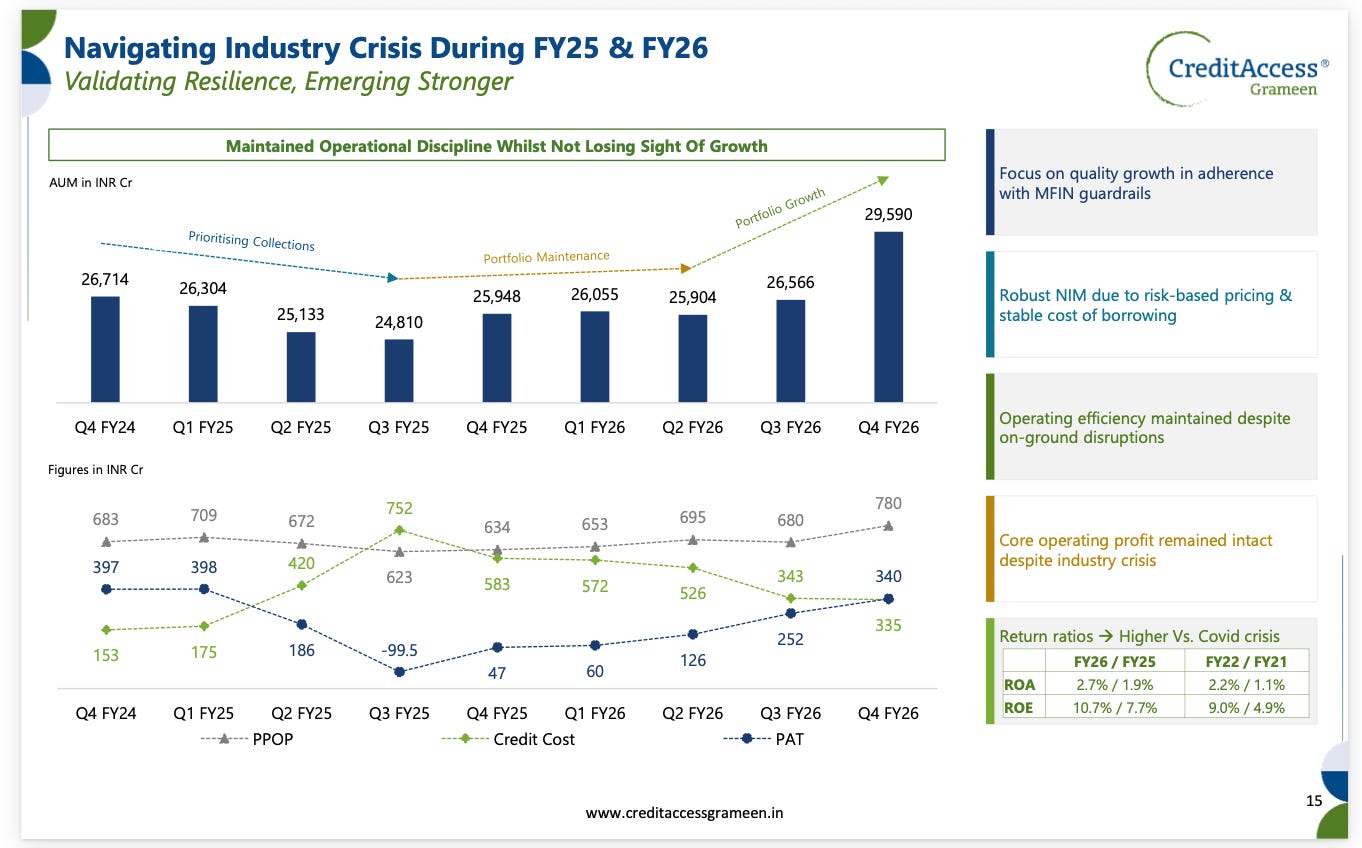
Look at the third row and the fourth row and then look at the second row again.
Credit cost went up nearly 5x. PAT went from +₹397 crore to a loss. But pre-provision operating profit — what the franchise actually earns before absorbing losses — fell about 9% and then made a new high.
That is the single most useful lesson in this whole episode. In a lending crisis, the P&L breaks but the franchise often doesn’t. The branches kept operating, the customers kept coming, the spread kept getting earned. What changed was how much of that spread had to be handed over to cover losses.
Which is why the correct question during the panic was never “what are earnings this quarter.” It was: is annual PPOP large enough to absorb the losses without eating into equity, and is the funding line still open? For CreditAccess the answer was yes — they never posted an annual loss (FY25 PAT: ₹531 crore), capital adequacy never fell below 24%, and gearing stayed around 3x. No rights issue, no dilution, no covenant waiver.
For others, the answer was no. Spandana Sphoorty lost ₹1,035 crore in FY25 and another ₹699 crore in FY26, wrote off ₹1,155 crore, saw revenue fall 56%, needed a ₹400 crore rights issue, and breached loan covenants (later waived). Fusion Finance lost ₹1,224 crore in FY25.
That difference was decided years earlier, in underwriting discipline and balance sheet conservatism.
Part 4: The green shoots, measured
Now the good news, and it is better documented than most recoveries.
The industry stopped shrinking. MFIN’s Micrometer for the March 2026 quarter recorded the first sequential portfolio growth in seven quarters — up over 3% to ₹3,25,174 crore. Quarterly disbursements of ₹77,524 crore were the highest in seven quarters, though still below the FY24 peak.
Asset quality is back to pre-crisis levels. PAR 31–180 fell to 2.0% in March 2026, from just over 6% a year earlier.PAR 31–90 is 0.8%.
In MFIN CEO Alok Misra’s words, the industry is turning the corner.
The new book is clean and it is now most of the book. This is the statistic I would put above all others.
CRISIL estimates that loans originated after the August 2024 guardrails now account for around 80% of MFI AUM, and PAR 90+ on that book is below 1%. The problem has largely been written off and replaced.
Lending discipline is visible in the mix. Around 95% of exposure now sits with borrowers linked to three or fewer lenders. Roughly 66% of AUM is to repeat borrowers in their second cycle or later, up from 53% two years ago.
Funding came back. NBFC-MFIs raised ₹77,870 crore of debt in FY26, up 30.9% year-on-year.
Policy turned supportive. In June 2025 the RBI cut the qualifying-asset requirement for NBFC-MFIs from 75% to 60%, letting them diversify a much larger share of the balance sheet into secured and individual lending. In March 2026 the government launched CGSMFI-2.0, a ₹20,000 crore credit guarantee facility covering 70–80% of default losses on bank lending to MFIs, since extended to 31 August 2026.
And the company-level evidence is now stacking up. CreditAccess did ₹340 crore PAT in Q4FY26 against ₹47 crore a year earlier, on 4.4% ROA and a quarterly credit cost of 1.21%. The June 2026 quarter update was stronger still: loan book ₹30,319 crore (+16.4%), record first-quarter disbursements of ₹6,107 crore, PAR 90+ down to 1.5%, collection efficiency 99.68%.
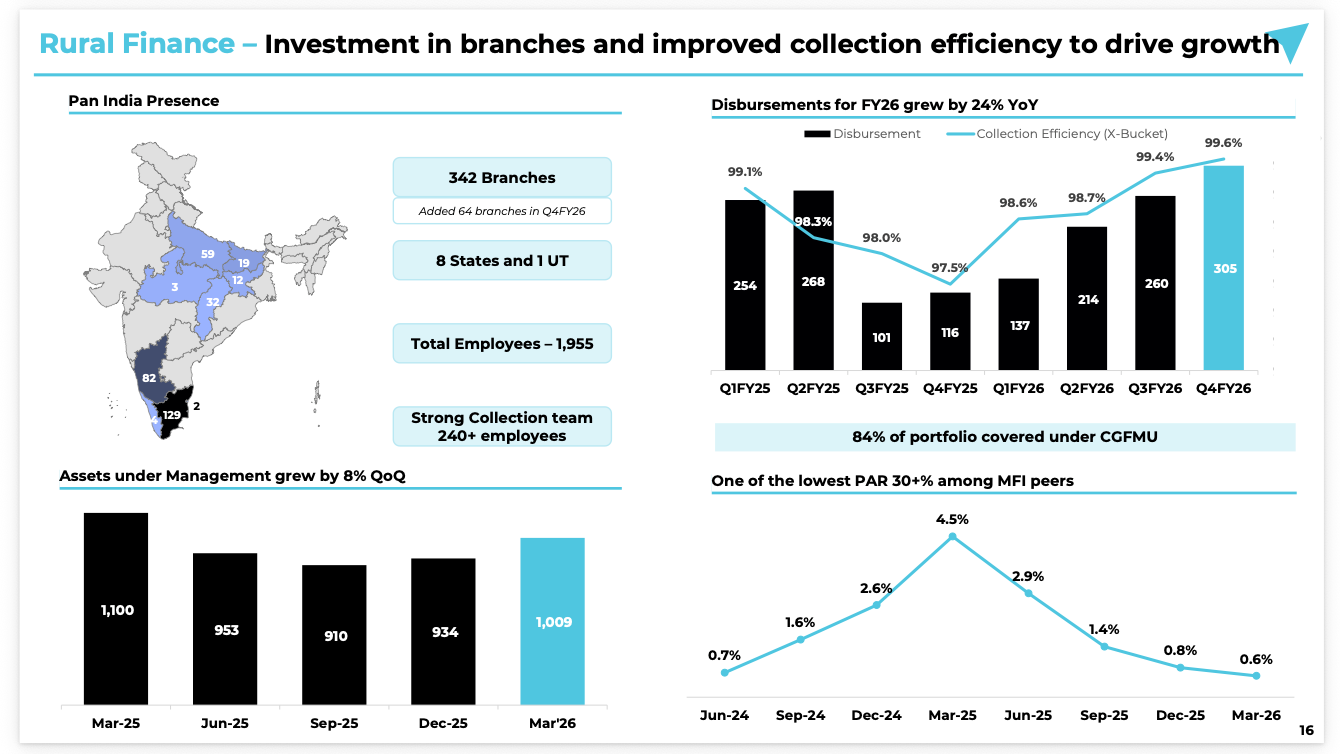
Northern Arc’s rural book tells the same story from a smaller base full-year credit cost down from 6.7% to 4.9%, the March quarter at 1.3%, X-bucket collection efficiency at 99.6%, and Karnataka recovering from 94.5% to about 99.5%. Note what they did with the book itself: cut it from ₹1,500 crore to about ₹900 crore during the storm, then rebuilt to ₹1,009 crore with 84% of it covered under CGFMU guarantee.
Even the wounded are stabilising. Fusion Finance turned a ₹1,225 crore FY25 loss into a ₹14 crore FY26 profit. Spandana posted ₹5.27 crore in Q4FY26 its first profit in six quarters.
CRISIL now expects sector AUM to grow around 20% in FY27, against 4% in FY26. ICRA sees credit costs falling to 3–3.5%.
I think the shoots are real
Part 5: Three things that stop me short of celebrating
First, the scar tissue is still on the books. PAR 180-plus including write-offs was still 16.3% in March 2026. Borrower count is still falling down 15.8% year on year.
So where is growth coming from? Larger loans to fewer, better-vetted customers. Average ticket size rose 18.3% to about ₹61,500.
Sit with that for a second. Rising ticket sizes to repeat borrowers is exactly the right strategy today and it is also precisely how the last cycle began. Every credit boom in history has started as a quality-led recovery. What matters is whether it survives the third good year, when a competitor starts writing ₹90,000 loans and your branch manager’s targets aren’t being met.
Second, the macro that produced this recovery has already turned. FY26 was a gift: inflation near 2%, the repo rate cut to 5.25%, two consecutive good monsoons, borrowing costs falling for every lender in this piece. FY27 opens differently. The IMD’s seasonal forecast is around 92% of the long-period average “below normal” with El Niño returning.
July was forecast under 94% of LPA after one of the driest Junes on record, and kharif sowing was running roughly 23% behind schedule in late June. The Agriculture Ministry has flagged 315 districts at risk, 111 of them with less than a quarter of farmland irrigated.
In June 2026 the RBI held rates at 5.25%, cut its FY27 growth forecast to 6.6% and raised its inflation forecast to 5.1%, citing energy prices and the West Asia conflict. MFIN itself, in the same release announcing the recovery, warned members to plan for a weaker monsoon and the conflict’s effect on rural livelihoods.
Microfinance borrowers are rural, cash-flow-driven, and weather-linked. This is the first monsoon that will actually test the new underwriting. Everything before this was tested against good rain.
Third the banks have not come back. Banks’ share of the microfinance portfolio has fallen to 26.4% from 32.6% a year ago.
CGSMFI-2.0 was designed precisely to fix this, with ₹20,000 crore of guarantee capacity. As of the June 2026 extension announcement, loans of just ₹770 crore had been sanctioned under it. The plumbing exists; the water isn’t flowing.
Misra’s own comment was pointed: the sector has done its part, and it is now time for banks to come forward.
A lending recovery is only as real as the liability side. We need to watch bank funding, not just collection efficiency.
Part 6: Five names, four different businesses
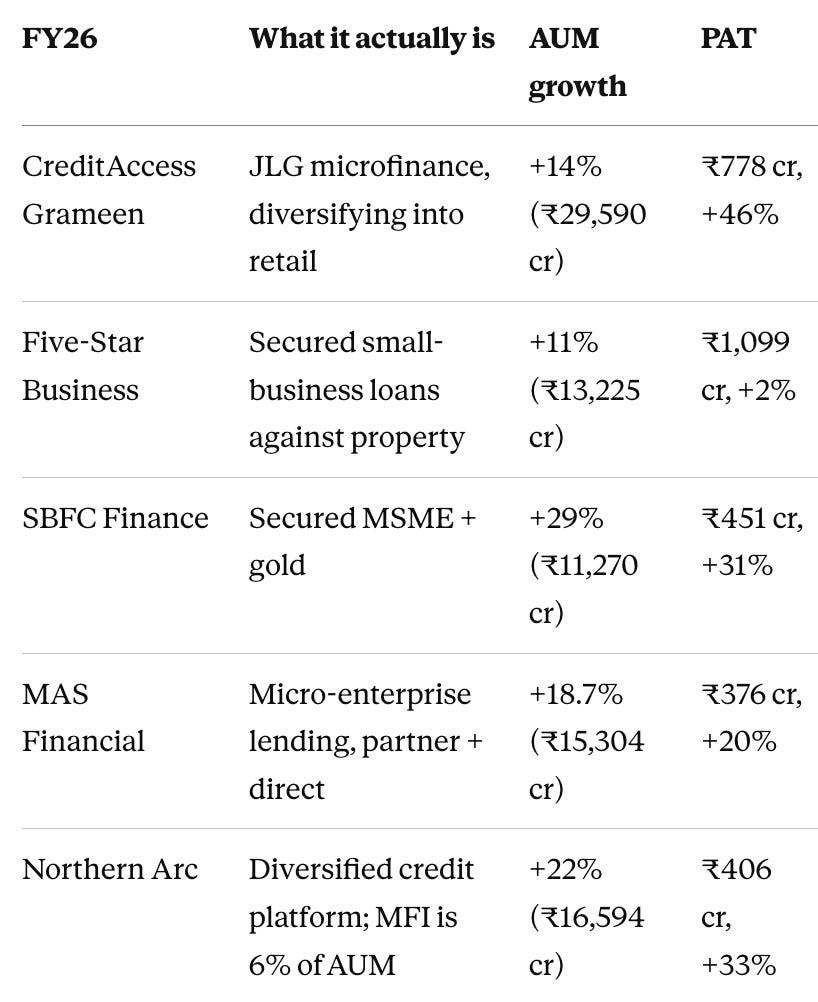
The whole sector is quietly converting itself from unsecured group lending into small-ticket household finance, partly secured. If you’re underwriting these companies on their 2021 identity, you’re valuing the wrong business.
Part 7: What you’re paying for the recovery
The uncomfortable part.
CreditAccess bottomed at ₹750 on 27 January 2025 the same week it reported a ₹99.5 crore quarterly loss. A global brokerage had by then cut its target to ₹564 and called the de-rating structural. Maximum reported pain and maximum analyst pessimism arrived in the same fortnight, as they almost always do.
It is around ₹1,490 today. Roughly a double in eighteen months, against a Dec-2023 high of ₹1,794.
At that price you’re paying roughly 3x March-2026 book and about 30x trailing earnings but those trailing earnings are cycle-depressed, still absorbing FY26 credit costs of 6.8%.
If management delivers its FY27 guidance of 20–25% AUM growth at a 4–4.8% ROA, that same price works out to somewhere in the mid-teens on forward earnings.
The entire bull case sits in the gap between those two numbers. And it requires guidance to be met in a year when the rain may not arrive, funding costs have stopped falling, and the RBI has just trimmed its own growth forecast.
That is not an argument against owning it. It is an argument for knowing precisely which bet you’re making: the operating recovery is evidenced, but a meaningful share of it is already in the price. The easy money the de-rating reversal from distressed to normal has been made. What’s left is execution money.
The lesson that outlives the cycle
Go back to CreditAccess’s ten-year table. Across FY17 to FY26 they disbursed ₹1,37,763 crore, collected ₹1,03,235 crore back, and wrote off ₹4,938 crore net of recoveries.
Roughly 3.6 paise lost for every rupee lent, over a decade that contained demonetisation, a pandemic, and the worst credit cycle the sector has ever seen.
Book compounded at 28.6% a year. Profit at 29.7%.
The business works. It just doesn’t work smoothly. Three crises in ten years, four if you count Andhra Pradesh in 2010 roughly one every four years. Anyone underwriting microfinance as a serene 25% compounder is underwriting an asset that has never existed.
The right question was never “will there be another crisis.”
It’s “will this lender still be standing, funded, and taking share when it comes?” which is a balance sheet question, asked years before you need the answer.
Which brings me back to the mat in the village, and the twenty women, and the register.
At CreditAccess, 99.68% of what was due in June 2026 came in on time. It always does, right up until the year it doesn’t. Both of those facts are true at once, and holding both of them in your head simultaneously is the whole job.
Watch the rain in August. Watch whether banks start lending. And watch ticket sizes because that is where the next one starts.
Written July 2026. All figures from company disclosures (CreditAccess Grameen and Northern Arc Q4FY26 and Q1FY27 filings and earnings calls), MFIN Micrometer, CRIF High Mark, and published reports from CRISIL, ICRA and CareEdge Ratings.
This is market commentary for education and discussion, not investment advice, and not a recommendation to buy or sell any security. I am not a registered research analyst. Please do your own work or speak to a SEBI-registered adviser before acting on anything here.
Brilliant article, Thanks for clarifying and articulating basic things , it really helped me , Keep writing....