
Mr Lucky is 40 and wants to retire, chose to retire in 2008 as he was made redundant with withdrawals from 2009 invested all savings in mutual regularly through years and build a corpus of INR 4 cr. Throught this post we use Franklin Tax shield fund which has one of longest NAV history in Indian markets to build and evaluate the case
Plan was simple retire by drawing 4% every year fixed 16L every year for rest of live
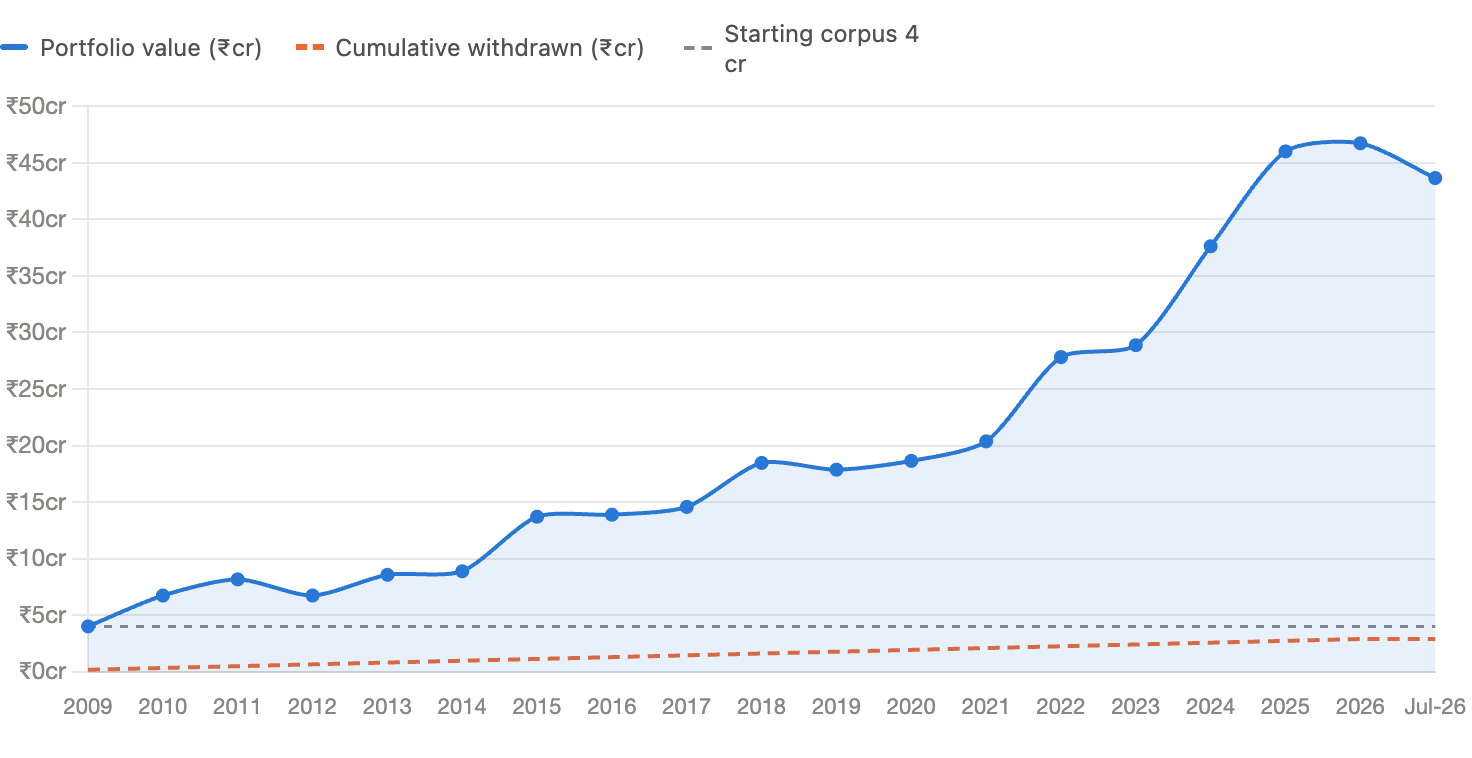
The 4% rule didn't just survive here it never even got stressed. Starting at ₹4 cr and pulling out ₹16 L a year, the man withdrew ₹2.88 cr over 18 years and still ended up with ₹43.66 cr. The corpus roughly 11×'d despite the withdrawals.
As reader you would say this not realistic as
The withdrawal is flat ₹16 L, not inflation-adjusted. The textbook 4% rule (Bengen / Trinity) raises the withdrawal with inflation every year. To hold 2009 purchasing power, that ₹16 L should have grown to roughly ₹45–50 L by 2026.
2009 was a near-perfect entry — right off the GFC bottom. Sequence-of-returns risk is brutal when you retire into a crash; here he retired into a recovery. Someone who started the same plan on 1-Jan-2008 would look very different.
So fix the issues, we withdraw a 10% inflation escalation, Even pulling 2.5× more cash out, the corpus still grew ~8.7× (₹4 cr → ₹34.68 cr)
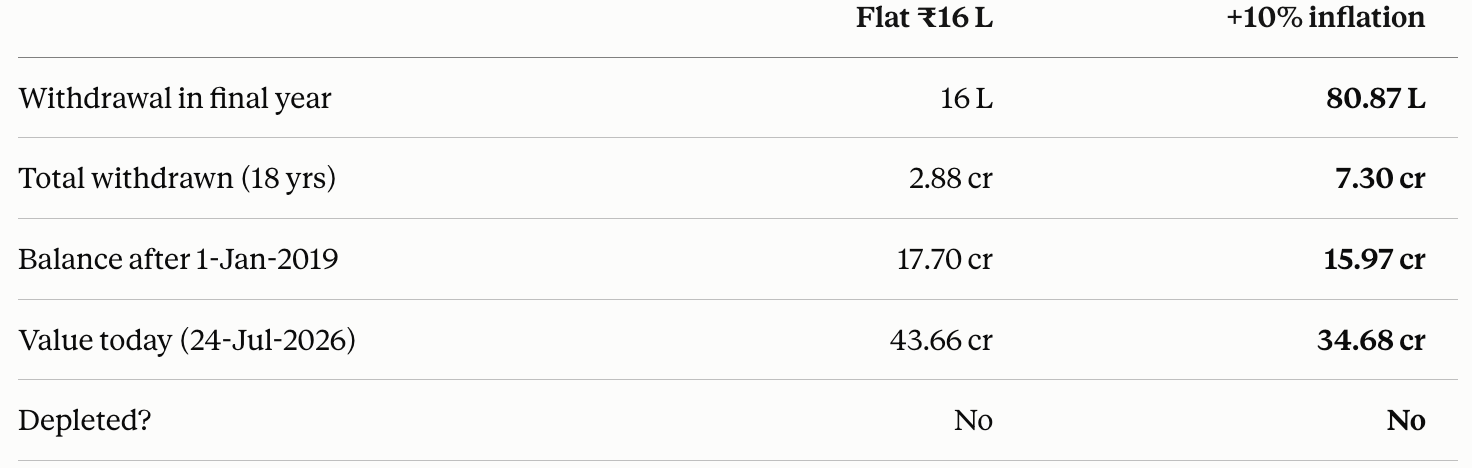
The real change is if we make it from near-perfect entry to near worst entry, what if Mr Lucky was Mr Unlucky and had retired in 2008 instead of 2009
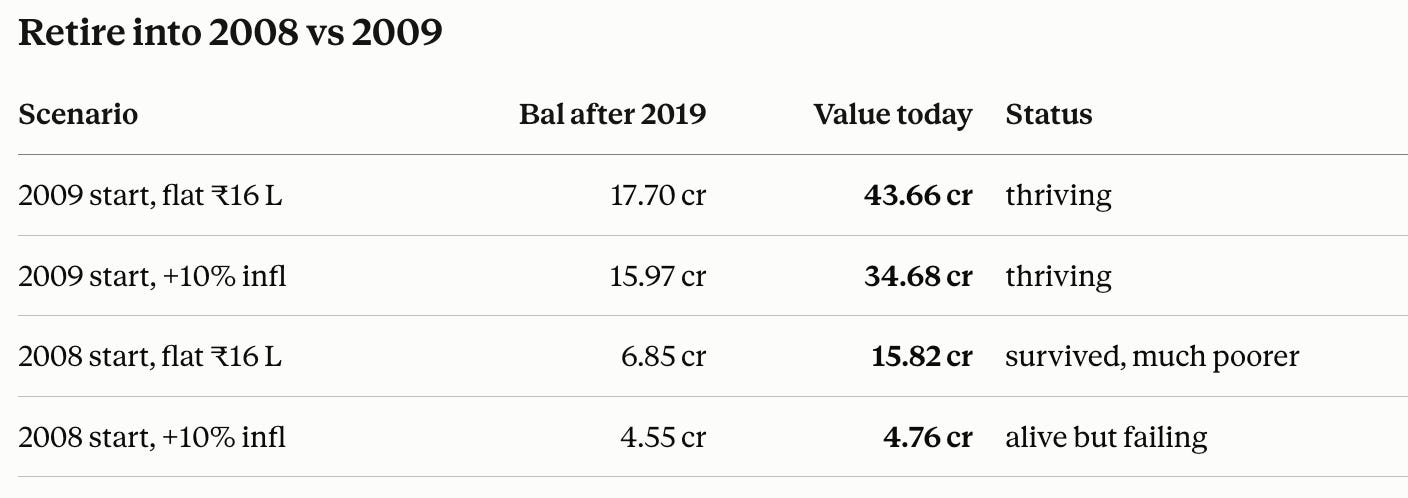
The one-year timing difference swings today's corpus by 2.8× (flat) and a staggering 7.3× (inflation-adjusted) — ₹34.68 cr vs ₹4.76 cr.
What the 2008 retiree lived through
In year one his ₹4 cr halved to ₹1.99 cr as the NAV fell ₹196 → ₹100 — and he still pulled his withdrawal out at the bottom, locking in the loss by selling units cheap.But the inflation-adjusted version essentially never recovered: it spent 19 years grinding between ₹4–6 cr while the withdrawal climbed to ₹89 L.
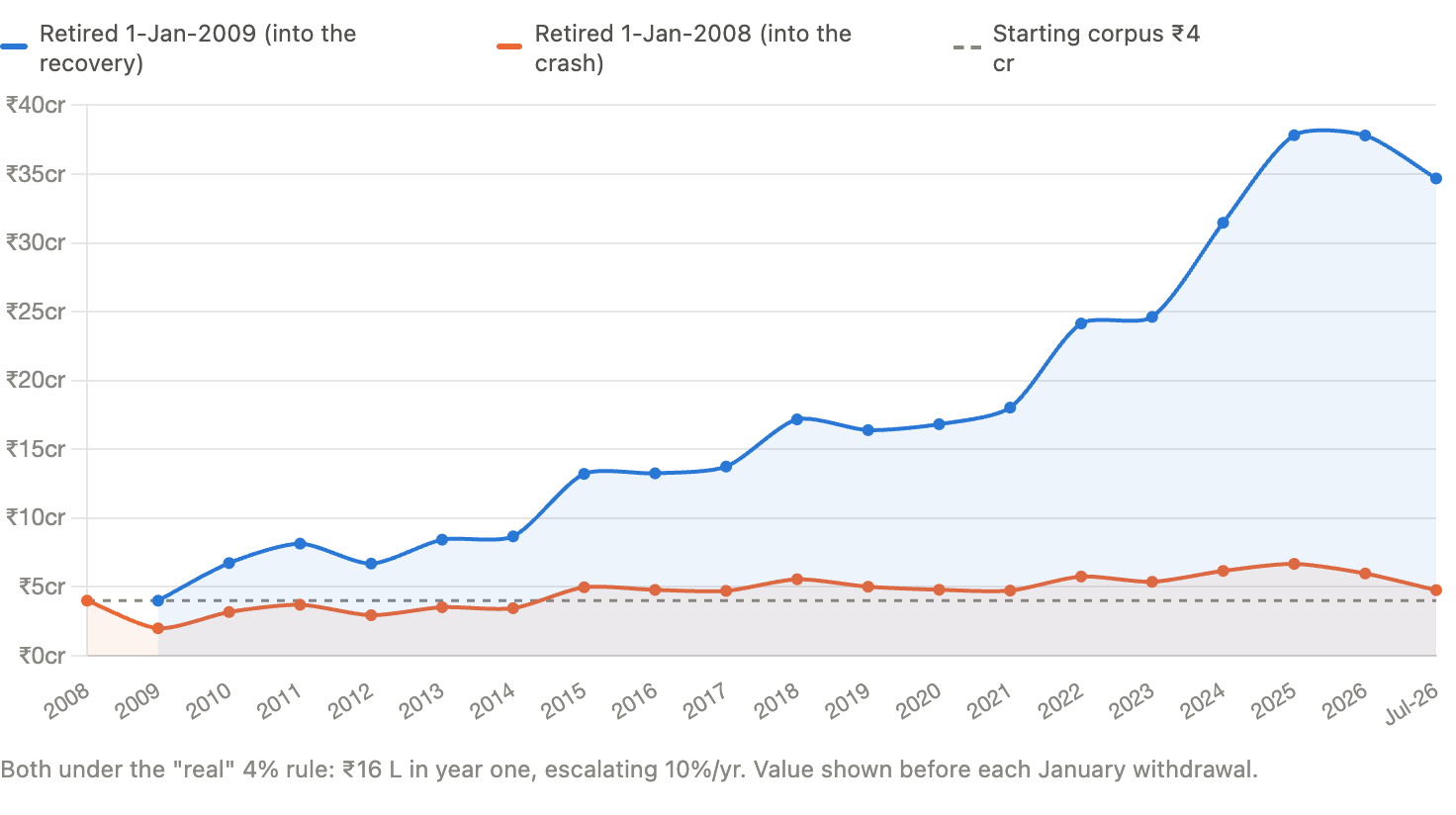
The 4% rule isn't really about the 4%. It's about the first two or three years. Retire into a bottom and even a naïve, inflation-lagging withdrawal makes you rich. Retire into a crash and the same rule on the same fund quietly bleeds you out
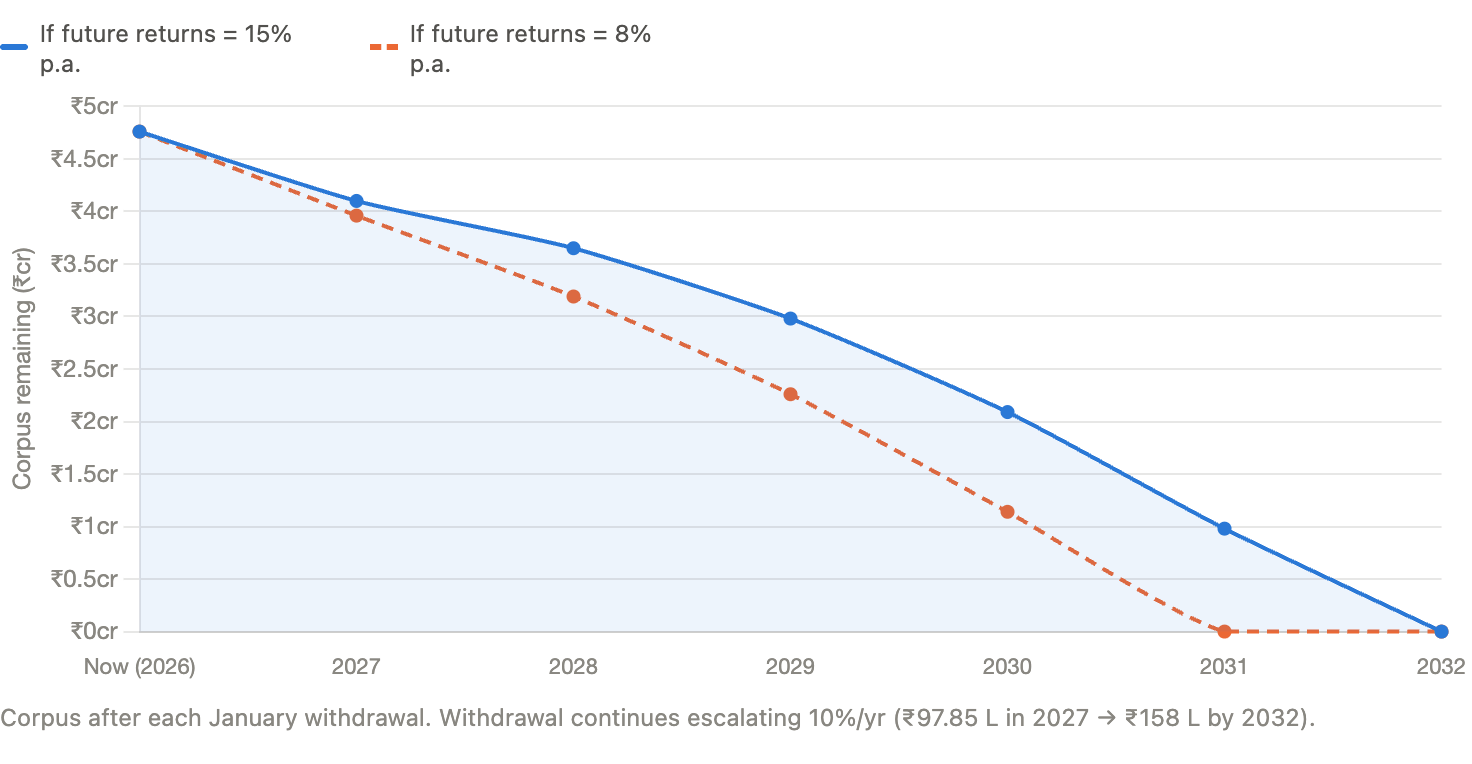
With 10% inflation and 2008 start, Mr unlucky is looking to get a bloody shock in his retirement life at 74 in 2031/2, the risk of running out money
So what can Mr Unlucky do?
When winds are turbulent behave properly if things go south you adjust and play the game handed to you
One simple fix is below rule
Rule: each year you spend the lower of {last year's amount + inflation, or ~5.5% of your current corpus}. That one change flips the 10%-inflation death spiral into indefinite survival
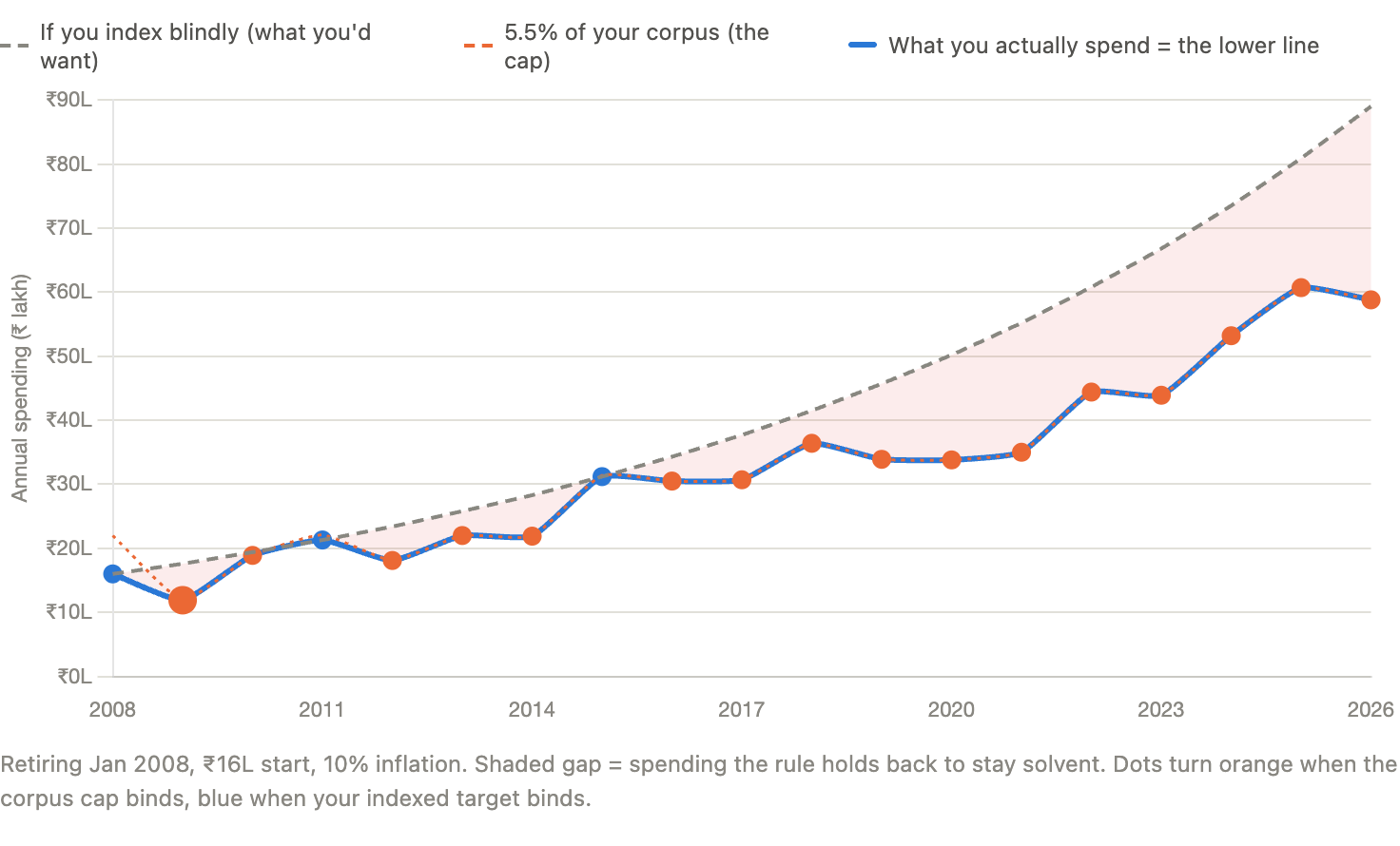
The blue line never rises above either dashed line that is the rule. In good years (2008, 2011, 2015, blue dots) your indexed target is the lower number, so you spend exactly what you planned. In every other year the orange cap is lower, so your corpus sets your budget.
The big red dot in 2009 is the whole point: the crash drags the cap down to ₹11.9 L, so you spend that instead of the ₹17.6 L you “wanted.” That one voluntary cut is what stops the death spiral.
And notice you’re not getting poorer the orange cap keeps rising because the corpus keeps growing. Your spending still climbs from ₹16 L to ~₹59 L; it just grows slower than the fantasy 10%-indexed line, which runs away to ₹89 L. The shaded gap is exactly the spending you defer to stay solvent.
You can’t control markets but you can control how you plan and react, if you like data drive retirement goal setting done via our mutual fund distribution arm get in touch