
Happy Independence Day
We are running an independence special, life time access to newsletter get it here
offer will close on Monday 17th August
Bonus* I will thrown in
BTC course
GOLD course
Silver Trend following indicator
All of above are worth more than $1000 USD, see you inside
*Activated after 72 hours
In the 1930s, while the Golden Gate Bridge was being built, one safety decision changed the psychology of an entire construction site.
A safety net was installed under the bridge during deck construction. It saved 19 workers who fell and survived; those men later became known as the “Halfway to Hell Club.” The net did not remove the danger, but it changed how people behaved around danger. It gave workers the confidence to keep doing hard work in a high-risk environment.
Investing in small caps works in a similar way, except for one uncomfortable difference.
There is no net.
When small-cap investors fall, they feel every inch of it. The long-term numbers may look beautiful, but the path to those numbers is psychologically brutal.
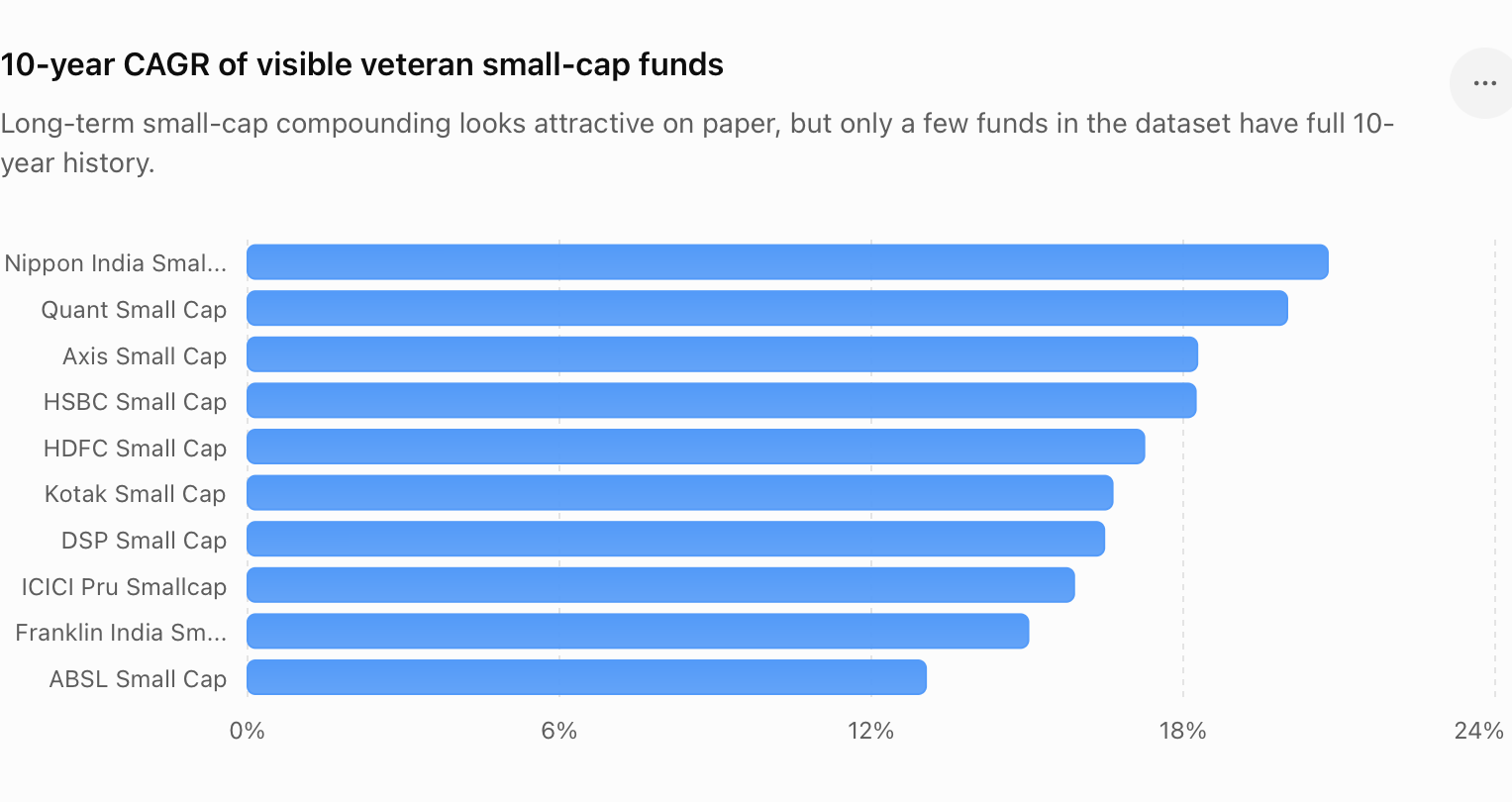
On a spreadsheet, these numbers look almost unreal.
Nippon India Small Cap shows a 20.78% 10-year CAGR. Quant Small Cap shows 20%. Axis and HSBC are both above 18%. HDFC, Kotak and DSP are all in the mid-to-high teens over a decade.
This is why small caps remain so attractive. At 17–20% annualized returns, money does not merely grow. It transforms.
But this is also where investors misunderstand the product. They see the long-term return and assume the experience will feel like the long-term return.
It never does.
The invoice arrives in the short term
The same funds that look impressive over 10 years can look ordinary, frustrating or even wrong over 1–2 years.
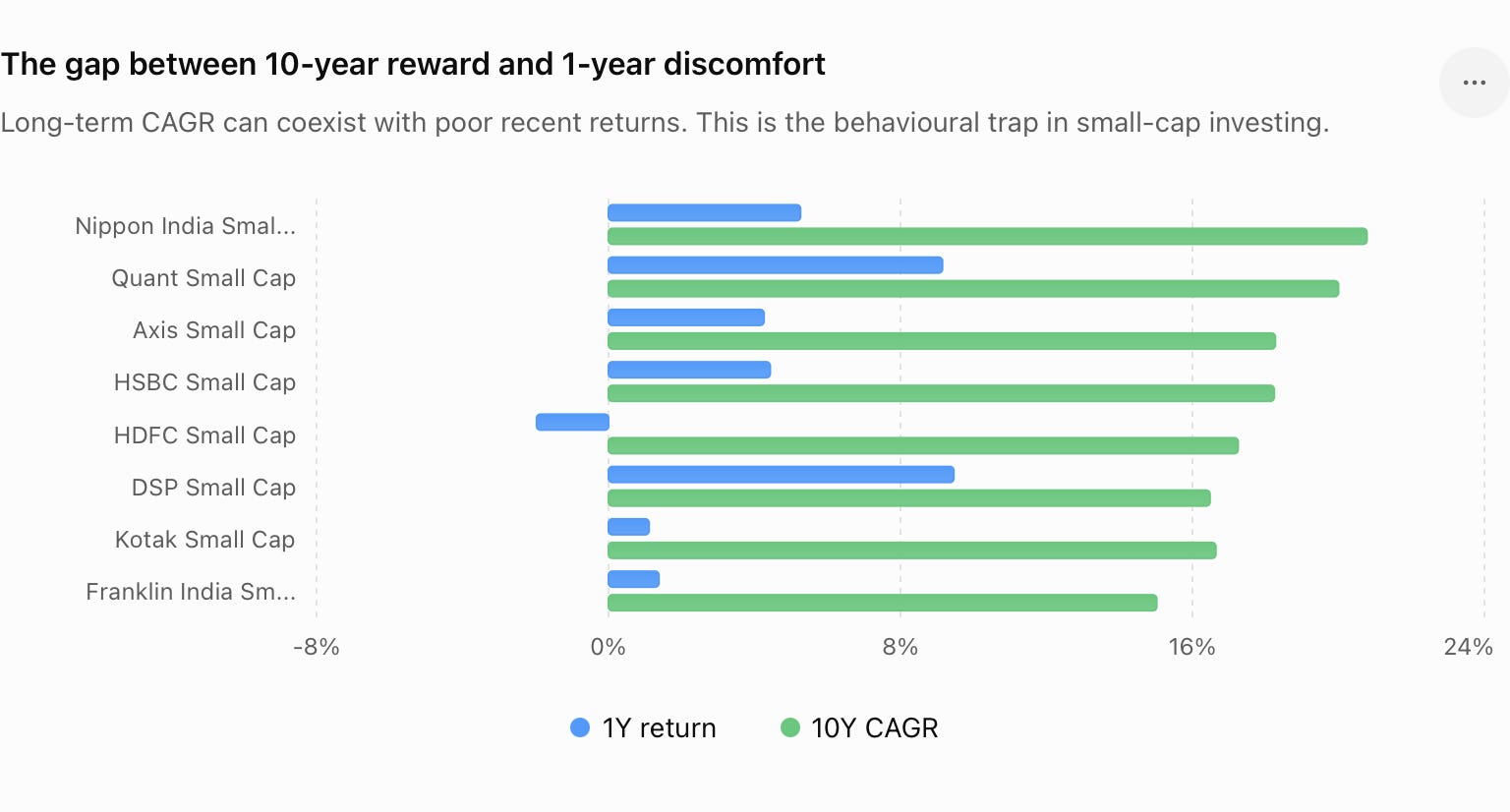
HDFC Small Cap has delivered 17.25% over 10 years, but its 1-year return in this dataset is -1.97%. Nippon has a 20.78% 10-year number, but the latest 1-year number is only 5.26%. Kotak shows 16.64% over 10 years, but only 1.11% over 1 year.
This is the emotional toll.
When you look backward at a 10-year chart, the bad periods look like tiny bumps. But when you are living through them, they feel enormous. A flat year feels like failure. A negative year feels like betrayal. A two-year period of weak returns makes investors question the fund, the manager, the category and themselves.
Small-cap investing is not mainly a return problem. It is an endurance problem.
Size itself becomes a variable
The other invisible issue is capacity.
A small-cap fund is supposed to hunt in smaller companies. But when the fund itself becomes huge, the game changes. It may still perform well, but it cannot behave like a nimble boutique fund forever.
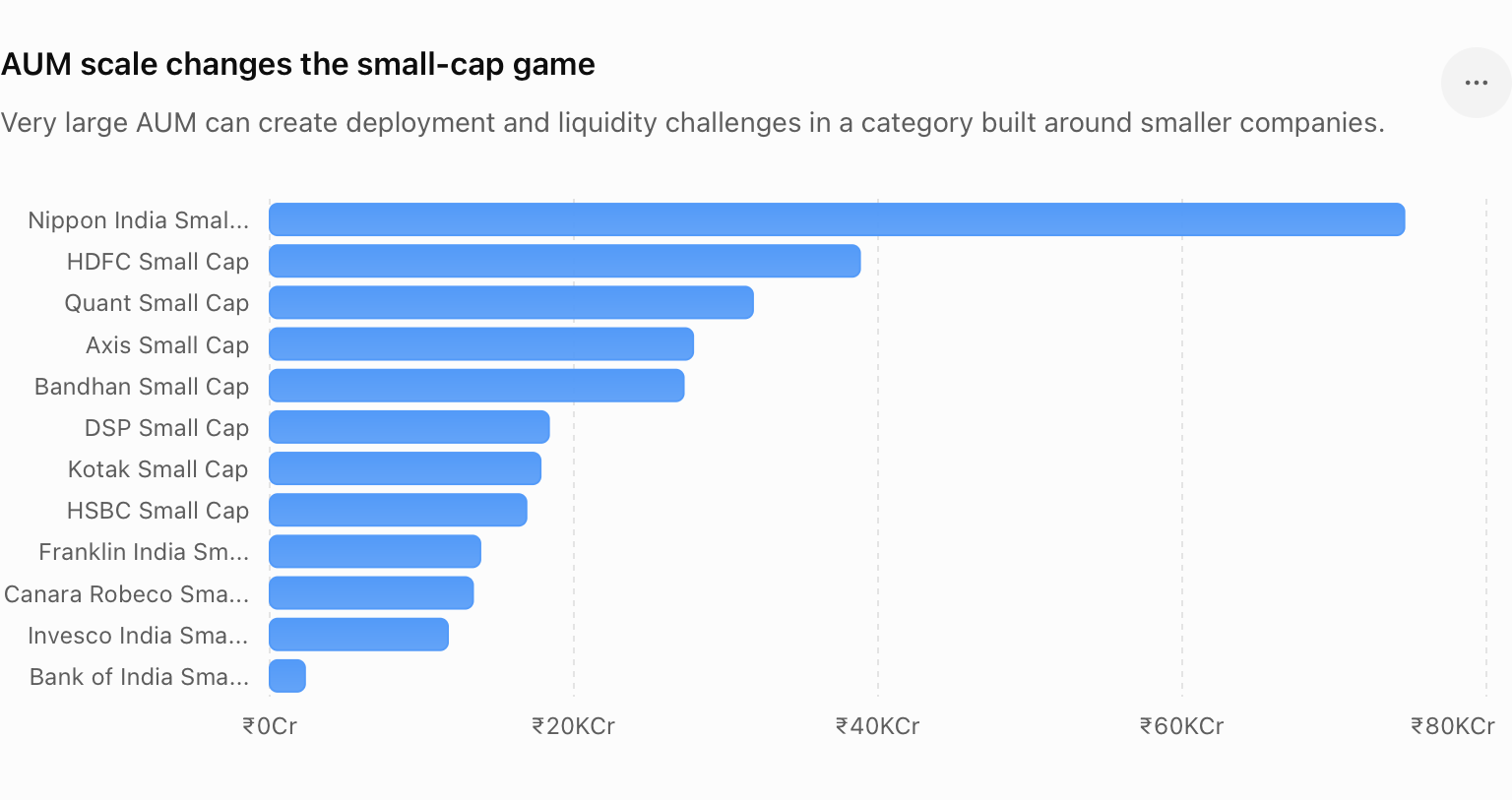
Nippon’s AUM is ₹74,604 crore. HDFC is at ₹38,809 crore. Quant is at ₹31,774 crore. Axis and Bandhan are both above ₹27,000 crore.
This does not mean these funds are bad. It means the question changes.
For a small fund, the question is: Can the manager find winners?
For a very large small-cap fund, the question is: Can the manager still find enough winners at scale without diluting the portfolio into a more mid-cap-like exposure?
That is why the most interesting research is not always in the obvious large names.
