
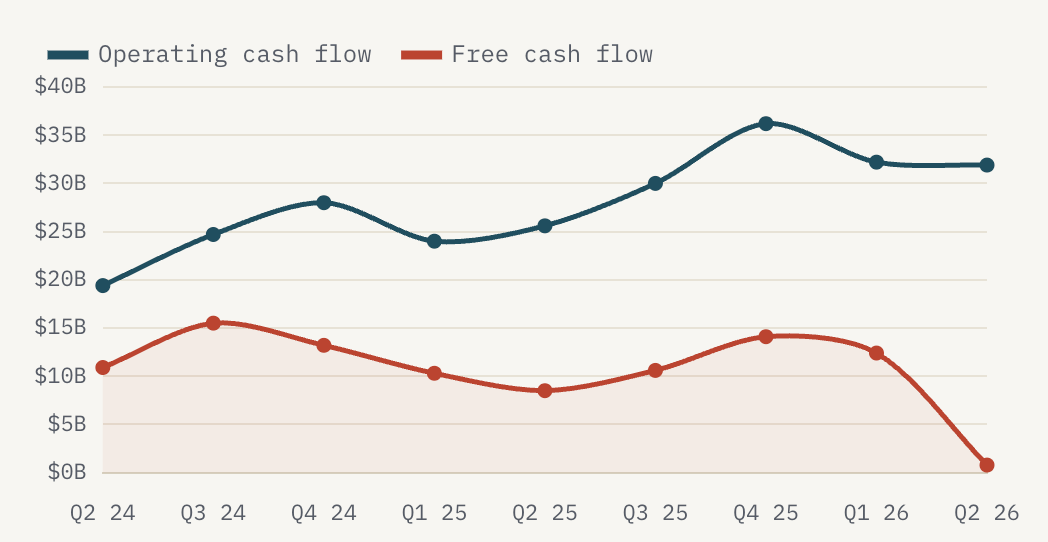
In Q2 2026 Meta's business generated $31.9 billion in operating cash. Its free cash flow was just $784 million. A quarter earlier, that number was $12.4 billion. A year earlier, $8.5 billion.
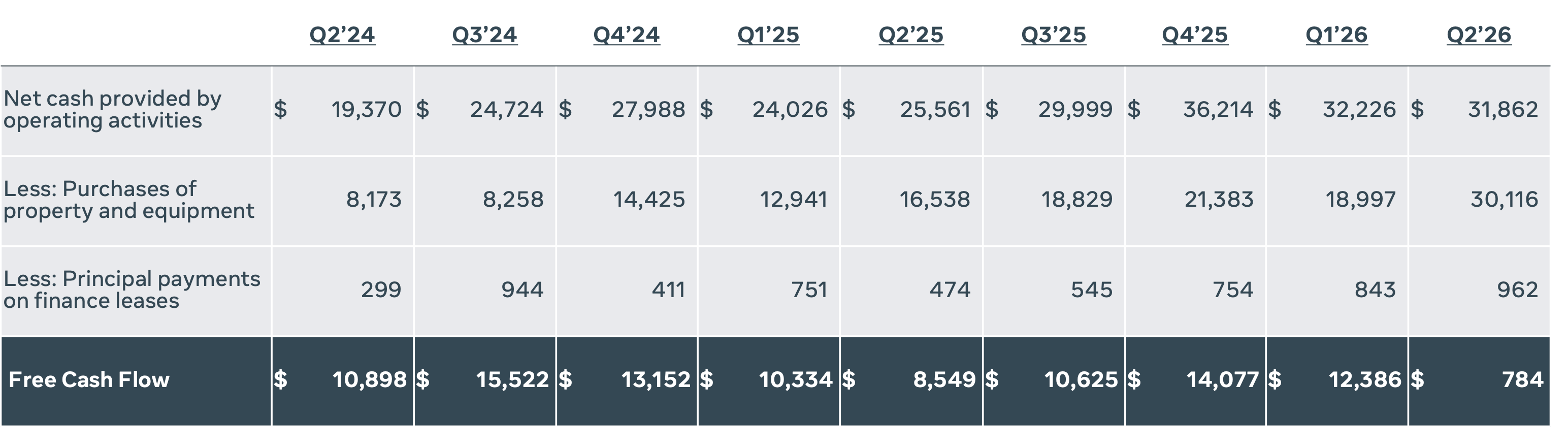
Capex is eating up FCF, This is not going to stop, Meta now expects to spend $130–145 billion on capital this year.
We have seen this film before Zuckerberg has take huge bets with operating cash flow
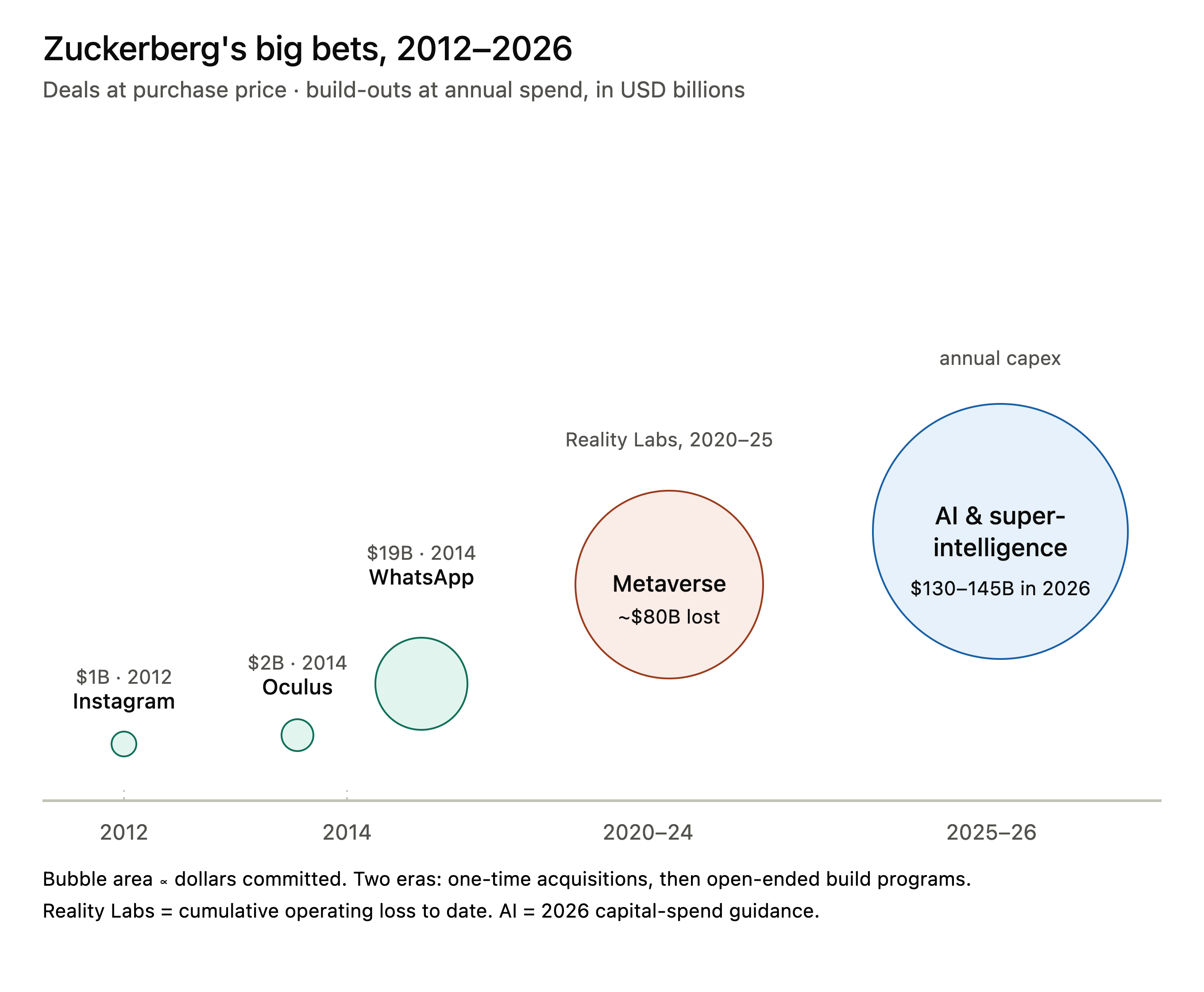
His last big bet Metaverse by all means of imagination is failed venture at least till now . His next one super intelligence can make or break company
It’s a big investment and it’s a big bet. We see the technology working… My personal bet is that the people who invest in this are going to be rewarded and feel very good over time.
— MARK ZUCKERBERG, Q2 2026 EARNINGS CALL
However the distinction this time is the change to balance sheet, yes META is borrowing and that too aggressively
To fund capex, Meta doing something it had never done as a public company. It is no longer cash fortress. As it now carries $83.7 billion of debt against $90.3 billion of cash, and it is reaching further afield for money this quarter read( data-centre venture with BlackRock)
One thing remain constant, its one best business on earth, Total revenue has jumped from $48B to $60B in a year
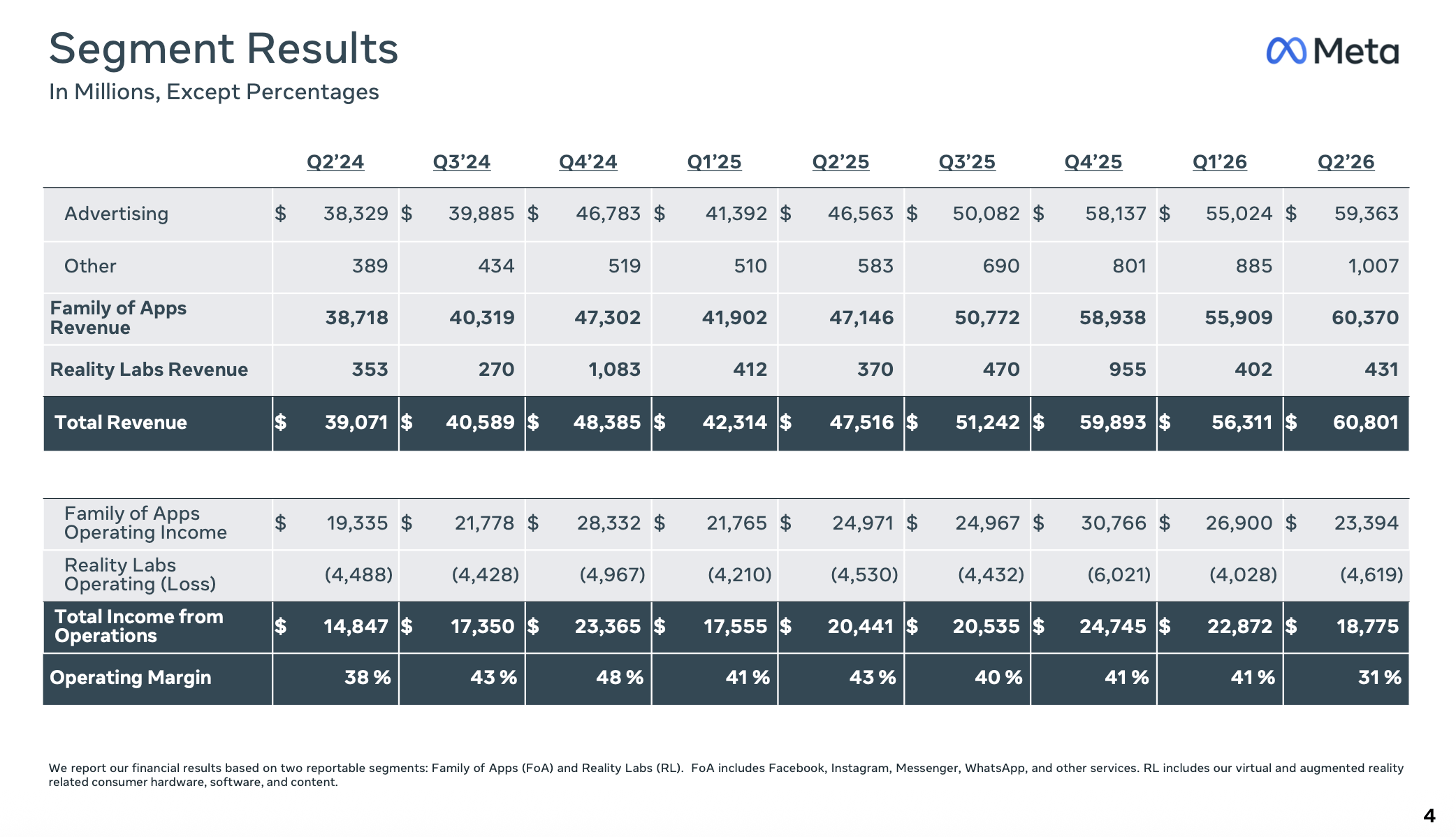
The operating margin however is now getting impacted with AI build out
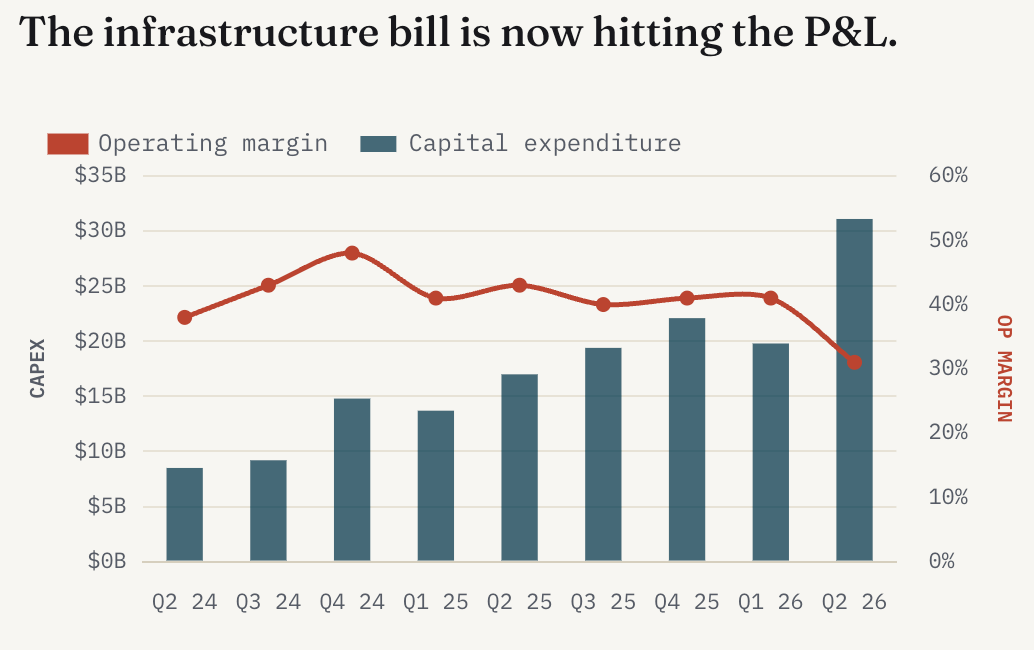
The market is not euphoric about this spending; it is sceptical. It is pricing in a real chance that the hundreds of billions going into AI never earn their keep
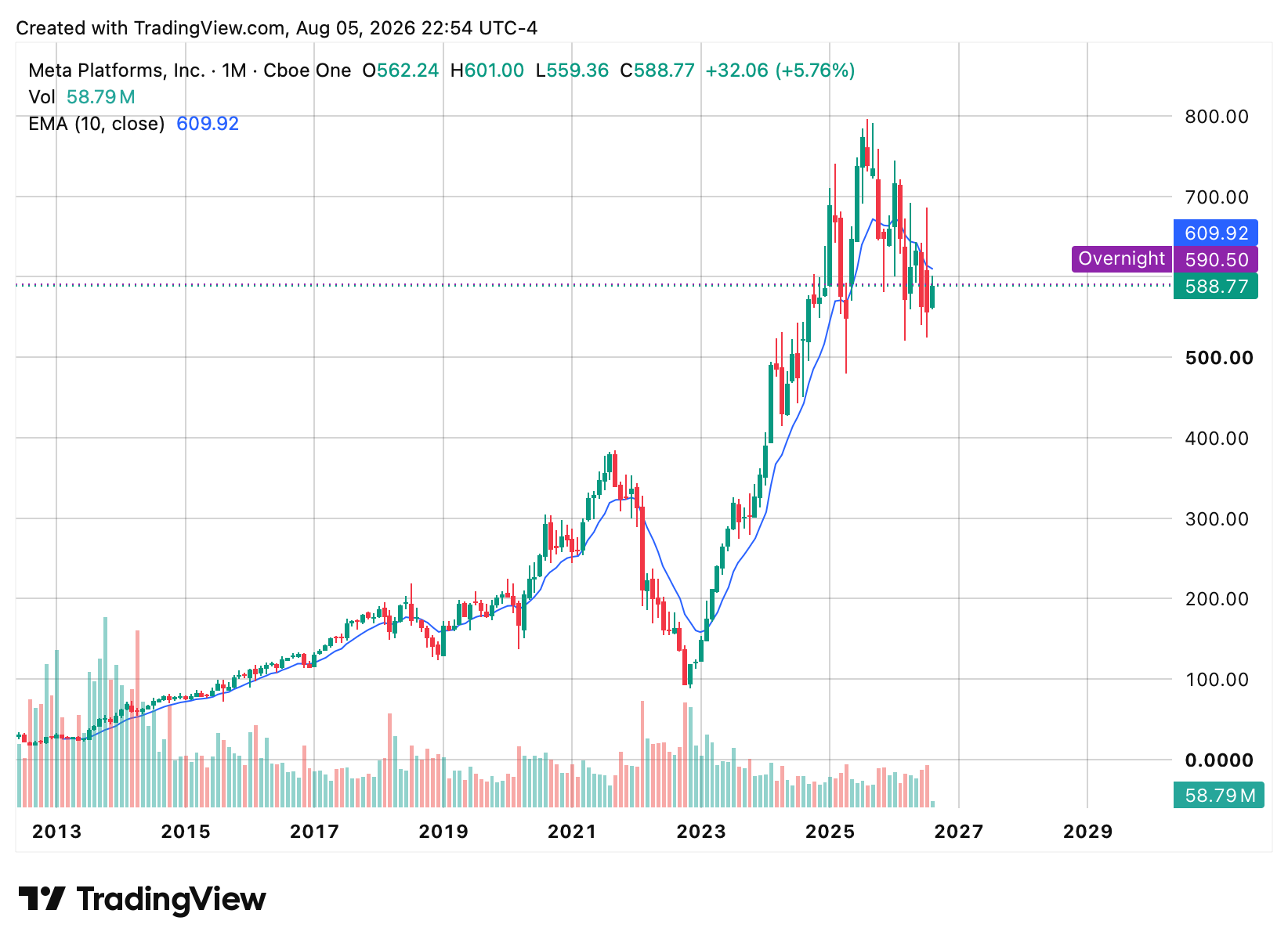
From technical on above monthly chart its broken its 10 month EMA and last time when that happened in 2021 price went from 380 to 100
Will the bet pay off?
There were number of call outs made in their Q2 transcript , what I have done is largely organised them in short, medium and long term prospect
Near-term payoff: AI is already lifting the core business
“On a dollar basis, our ads business is reporting faster year-over-year revenue growth than any other company’s reported ad business -- so these AI investments are paying off.”
“9 million small businesses on our platforms are now using at least one of our AI ad creative tools, and we’re rolling out new end-to-end creative solutions that help advertisers translate performance data into their creative decisions. Muse Image is going to supercharge this.”
“Since we rebuilt Meta AI and integrated Muse Spark, we’ve seen a 60% increase in the number of people interacting with the assistant each day and that continues to grow quickly week-over-week.”
“On Instagram, global time spent this quarter grew double digits year-over-year, largely driven by improvements to our Feed and Reels recommendations. On Facebook video time spent increased 9% globally year over year and over 10% within the US & Canada.”
“In Q2, we also advanced our user understanding models to analyze ads and organic activity and simultaneously improve both user experience and advertiser performance. Combined with our GEM model for ads ranking and sequence learning, these advancements generated an 8.3% increase in ad clicks and a 15.7% uplift in conversions on Facebook.”
“Our AI-powered Advantage+ end-to-end solutions continued to grow, reaching over $75 billion in annual revenue run-rate this quarter.”
Medium-term payoff: New products that leverage the same infrastructure and distribution
“Soon, we will have agents that can work 24/7 on your behalf to help achieve your goals and improve your life, your health, your relationships, your finances -- whatever you want. … this needs to be a great consumer product that just works out of the box and is easy enough for billions of people to adopt and use.”
“We made Meta Business Agents available globally this quarter on WhatsApp and Messenger, and there are already more than 1 million businesses using them to talk to their customers or complete sales every week. We’re rolling business agents out on Instagram now too. … Over time, we’d like to build this into a business-in-a-box service that can help you start and run a whole business using Meta’s platforms.”
“In terms of how we will monetize these, we have a mix of subscriptions, volume-based pricing, and I expect that we’re going to evolve more of these products to be like our ad systems where businesses only pay us when we achieve results for them. Over time, that will let us run an efficient auction over our compute, similar to how we do that for our advertisers today.”
“We’ve built our API, we’re rolling out business agents, we’re getting a lot of offers for compute at a significant premium over what we paid for it, and we have more coding and productivity tools on our roadmap as well.”
“We just released our own line of Meta Glasses in collaboration with EssilorLuxottica, including a style that we designed with Kylie Jenner. They’re the first glasses to ship with Muse Spark out of the box so that they can understand what you’re seeing and give even more helpful answers. Early sales have been strong, exceeding our expectations.”
Structural / long-term payoff: Full-stack + distribution moat?
“I think that we’ve definitely shown at Meta that when we have a product in a format that works, I would go as far as to say that I think we’re probably the best company in the world at scaling those experiences to billions of people.”
“We are really a full stack technology company. We built our own data centers, our own infrastructure, our own chips, our own low-level software. … It just seems to me pretty clear that having kind of sovereignty over building your own models is going to be an important part of that stack going forward.”
“I believe that building the kind of full stack model is going to be a lot of the durable advantage over time in how we build personal superintelligence agents, business agents, all these different use cases for all of the different customers that we want to serve.”
How the economics are supposed to work?
“Overall, we expect that a significant portion of our compute is going to go towards training our models, growing our core business, and delivering personal agents and new products. But we also expect to grow a large business serving large customers as well.”
“We believe that there will continue to be a significantly higher margin on selling intelligence rather than selling compute directly. But we think that there’s a big opportunity obviously to sell compute as well.”
“Our current plans are geared towards maximizing 2026 and 2027 capacity. … Longer-term capacity strategy aims to give us the flexibility to continue growing compute in 2028 and beyond by laying down data center and network foundations to accommodate future server decisions.”
“Infrastructure planning remains highly dynamic and even this year, there are a range of outcomes embedded in our outlook.”
“We are today, and expect to be in the sort of foreseeable future, supply constrained, and that really includes our core business, too, where there are -- we still have numerous ROI positive places that we would put compute toward if we had it.”
“AI is improving our core business -- it’s making our apps more relevant, and delivering better results for businesses. We’re starting to deliver more novel products, and we’ll have a lot more there soon as well. We’re investing aggressively because the potential is huge and we know that there are many ways to deliver value here.”
I can do DCF math and tell you fair value of share is $700 or $500 by you using aggressive or conservative assumption but main question as investor you need answer it will Zuck get it right this time?
For me I am interested and tracking
Written by hand typing,
Vivek
very well written vivek...