
First up read the original article
Tesla

It is November, so ask me anything and I will sent a video response to you in December , Click Ask
Is Mr Market giving us the 2022 kind of valuation after recent fall
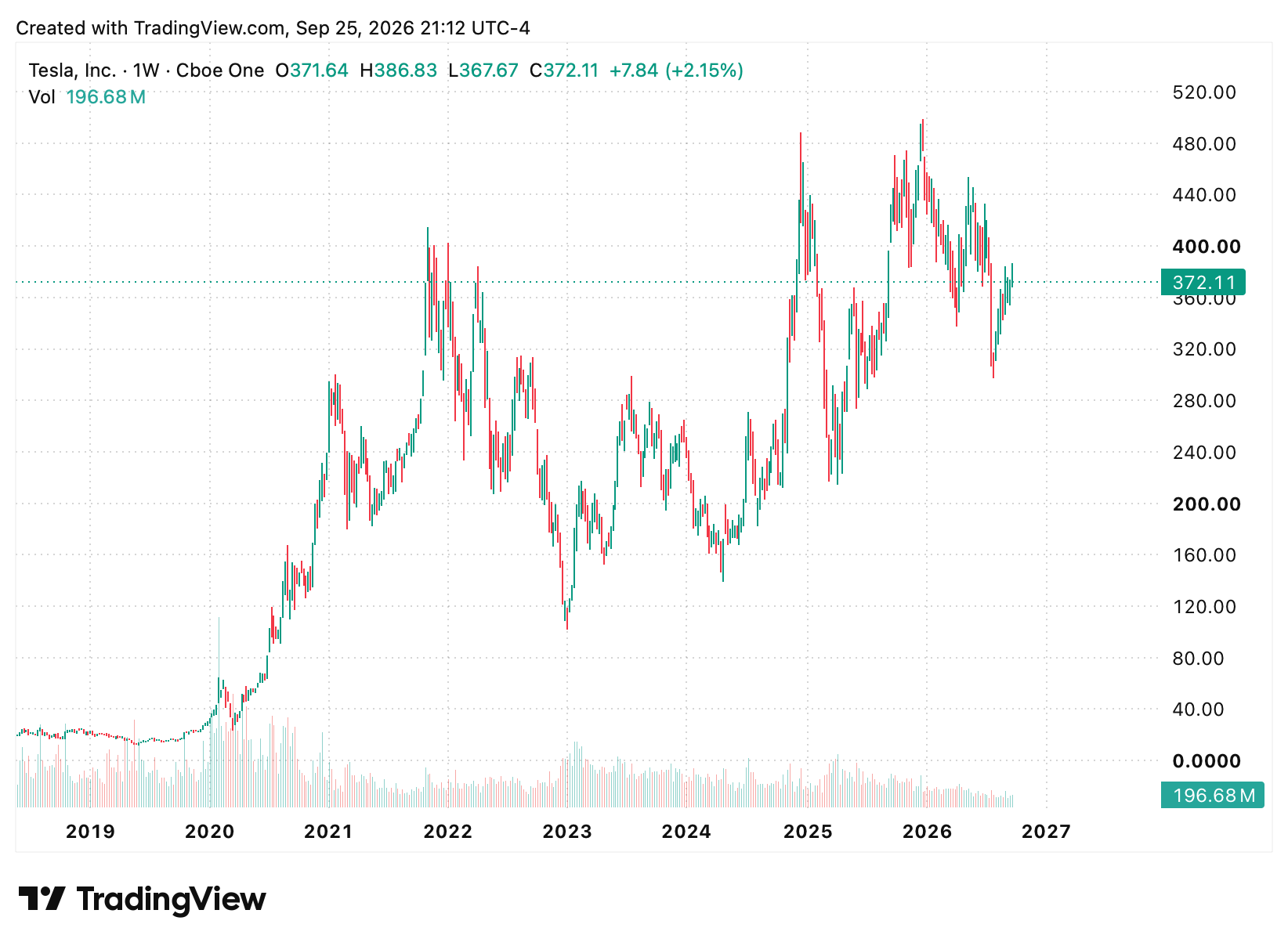
Sep 2026
Back in November 2024 I wrote a note on Tesla to expand my own knowledge of the business. The last paragraph is the one that keeps coming back.
Mr Market provides us opportunity to load up business like Tesla every 2-5 years, when temporary bad time comes like it did in last quarter of 2022 when Tesla was priced 30 times its depressed profits we could have batted well.
Two questions follow from that sentence.
Has the temporary bad time arrived?
And if it has, is Mr Market pricing the business at 30 times those depressed profits, or is he doing something else?
This is a follow up note.
# What I said then, and what actually happened
In Nov 2024 the stock was a roughly $800 billion company. Traditional metrics already looked stretched.
8 times sales
80 times profits
FCF yield less than 2%
On the other side of the ledger I had four things.
Toyota still sold about 10 times more cars
Energy storage was just starting to scale
Tesla had a track record of delivering the unimaginable
It could be the first company to bring human like AI to factory and homes
I also laid out the flywheel.

Cars collect data. Data trains FSD. FSD feeds insurance and robotaxi. Energy sits next to the car. Manufacturing gets more vertical. Humanoid robots sit at the end of the same AI stack.
That flywheel is still the bull case. What changed is the cost of spinning it, and the price Mr Market is asking you to pay while profits go the other way
Updates to thesis
Capex
In 2024 management was guiding a $10 to $11 billion run rate for the next 2-3 years. I wrote that most of it would not be on automotive. That part was right. The number was not. Capex in Q2 2026 alone was $5.8 billion. Full year 2026 guidance is now more than $25 billion The extra is AI compute, Cybercab, Optimus lines, data centres. The flywheel is no longer a cheap option sitting on top of a cash generating car company. It is the capex budget.
Energy
I expected energy to be a $20 billion division in 2025. It did scale, and it is now a real second engine, but 2025 energy revenue came in closer to $13 billion. Deployments are lumpy. Margins, which looked fat, got clipped in 2026 by warranty charges, expired tariff benefits and falling industrial storage prices. The direction I had was right. The 2025 dollar figure was wrong.
Cars
Automotive revenue had already started tiring in 2024. It tired some more in 2025. Deliveries fell two years in a row. 2026 volume has come back, including a strong Q2, but it came back the way I said Tesla would defend share. Lower sticker. Cheaper trims. Financing. That is exactly the strategy list from the original note. More cars, less profit per car.
BYD and China
Still the right watch item. Anyone tracking Tesla still has to look at how they defend Europe, USA and China against BYD and the rest of the Chinese pack. It is no longer a future risk. It is why average selling prices keep leaking.
Has the temporary bad time arrived?
Yes. On profits.
Peak year was 2023. Tesla made about $15 billion. EPS was $4.30.
Then the slope.
2024 profit $7.1 billion
2025 profit $3.8 billion
Trailing twelve months to June 2026 still about $3.8 billion
Trailing EPS about $1.08
That is a 75% haircut from the peak year. Revenue did not collapse with it. Trailing sales are about $104 billion. The company is selling enough. It is keeping far less.
Q2 2026 is the cleanest recent snapshot of the new shape.
Revenue $28.2 billion, up 26%
Deliveries 480,126, up 25%
Operating income $398 million, down 57%
Operating margin 1.4%, down from 4.1% a year earlier
Free cash flow minus $1.1 billion
They sold more cars and made less money. GAAP net income in that quarter still printed $1.1 billion. Do not get hypnotised by that line. A large mark to market gain on the SpaceX stake sat underneath it. The number that tells you how the operating business is travelling is the $398 million of operating income.
So the first half of my 2024 sentence is on the board. Temporary bad time, yes.
Why profits compressed
Five things stacked on top of each other. None of them is a mystery.
1. Price for volume
Tesla cut list prices, launched stripped down Model 3 and Model Y variants, and leaned on cheap finance. Average revenue per vehicle in Q2 2026 was about $42,730 against $45,345 in the prior quarter.
Auto gross margin excluding regulatory credits was 16.3% in Q2. In the fat years of 2022 and 2023 it was mid 20s to around 30%. Profit per car has gone from something like $6,000 plus to a bit over $2,000.
Model 3 and Model Y were 97% of Q2 deliveries. The high ASP cars are not carrying the P&L. The company is doing what I wrote they would do, make the entry car cheaper so more people can buy it. That works for share. It does not work for 2023 style margins.
2. The credit cushion is dying
Tesla used to sell emissions and fuel economy credits to other carmakers. That line is almost pure profit.
2024 credits $2.76 billion
2025 credits $1.99 billion
Q2 2025 $439 million
Q2 2026 $146 million, down 67%
In 2025 those credits were still more than half of reported net profit. They are fading because the rule that created demand for them is being unwound. The $7,500 US federal EV tax credit expired on 30 September 2025. Fuel economy penalties that forced rivals to buy Tesla credits have been eased. This is policy, not a Tesla execution miss. It still leaves a hole in the P&L.
3. US demand was hit, then they discounted to refill the factories
Two years of falling deliveries, 2024 and 2025, came before the 2026 rebound. The US lost the $7,500 credit. EV rules were loosened. Brand became political. Europe bounced in 2026. The US did not fully. Tesla then did the rational factory thing, cut price, fill the line. Volume returned. Margin did not.
4. AI, robotaxi and Optimus are now a P&L tax
This is the biggest change versus the 2024 note.
In Q2 2026 Tesla said, in so many words, that heavy R&D to accelerate AI, software and fleet based profits will negatively impact profitability during this phase
Operating expenses up 47% to $4.35 billion
R&D up 49% to $2.37 billion
Capex up 142% to $5.79 billion
Full year capex guided above $25 billion
Free cash flow minus $1.1 billion
Robotaxi, Cybercab, Optimus and AI compute are real cash leaving the building. They are not yet a real earnings line. FSD subscriptions are growing and services margins have improved. That is the first small royalty from the flywheel. It is nowhere near large enough to replace 2023 auto profit.
5. Energy grew, its fat margin did not
Energy storage had a strong deployment quarter in Q2, 13.5 GWh. Gross margin still fell from 39.5% in Q1 to 20.4% in Q2. A $240 million warranty charge on vendor cells, $200 million of Q1 tariff benefits that did not repeat, and industrial storage prices coming down as competition showed up.
Energy is the second engine. It is not plugging the auto hole.
Factory costs did get better. That is why Tesla is still profitable and still prints the highest profit per car among volume automakers. Cost cuts just did not keep up with ASP down, credits gone and opex up.
Now the second half of the sentence. Is it 30 times?
No.
Late 2022 / early January 2023, the window I pointed to.
Price $108 to $123
Market cap roughly $340 to $430 billion
Trailing EPS $3.62
Trailing P/E about 34 times at $123, about 30 times at the $108 low
2022 profit was still $12.6 billion
That was a price crash on still high earnings. Musk, Twitter, demand scare, price cuts, rates. Profits had not yet collapsed. The multiple did.
Today, September 2026 close.
Price about $372
Market cap about $1.47 trillion
Trailing EPS about $1.08
Trailing P/E about 350 times
Forward P/E about 160 to 210 times on 2026 consensus EPS of roughly $1.78
Apply the same 30 times rule I wrote in 2024.
30 times current trailing EPS $1.08 is about $32
30 times 2026 consensus EPS $1.79 is about $54
30 times peak 2023 EPS $4.30 is about $129
Spot price $372 is about 11 times the 2022 trough and about 10 times richer on trailing earnings than that setup.
Even the recent 52 week low of $297 in July 2026 was still around 275 times trailing earnings. Not 30 times.
The company is foregoing a lot of current profits to come out as winner in as preferred AI hardware firm
Why the multiple refuses to compress
In 2022 the market briefly valued Tesla as a car company with growth risk.
In 2026 the market is valuing Tesla as an AI option that happens to ship cars. Robotaxi, Optimus, FSD, AI chips, the same flywheel I drew in 2024. That is why earnings can fall 75% from peak and the stock can still sit near $370, only about 25% off a $499 high printed in December 2025.
I am not going to pretend I can put a clean dollar value on that option. I said the same thing in 2024. Cutting edge innovation, large opportunity size, Elon, culture. Hard to put a number on. That sentence is still true.
What I can do is refuse to confuse the option with the 2022 setup.
If robotaxi and Optimus work at scale, today’s earnings do not matter. That is the bull case, and it is internally consistent.
If they take longer, or capex stays above $25 billion for years, or FSD never becomes a large paid network, then you own a 16% auto margin car and storage company at 14 times sales and 350 times trailing profits. That is also internally consistent. It is just a very expensive way to own a car company.
The original note already had this tension. Traditional metrics said overvalued. The flywheel said do not use traditional metrics. Twenty two months later the tension is wider, not narrower. Profits went down. The multiple went up.
What I am watching from here
Same list as 2024, with the new numbers attached.
1. Auto ASP and margin excluding credits. If 16% is the new floor and volume keeps growing, the auto engine can still fund the flywheel. If ASP keeps leaking, it cannot.
2. Regulatory credits. Treat them as a melting ice cube. Do not underwrite 2027 earnings on 2024 credit income.
3. Energy deployments and energy gross margin after the warranty noise. This is the only current business that can become a second profit engine without waiting for robotaxi regulation.
4. FSD paid subscribers and services margin. This is the first royalty from the data flywheel. It has to start showing up as dollars, not just miles.
5. Capex versus operating cash flow. $25 billion plus of capex against a mid single digit billion profit base is a funding question, not a vision question. Management is already lining up large debt capacity. Watch dilution and interest.
6. BYD and China in each of Tesla’s three big markets. Still the right competitive test.
Conclusion
The flywheel I wrote about is still the reason Tesla is an interesting business.
Cars → data → FSD → insurance and robotaxi
Energy next to the car
Manufacturing getting more vertical
Humanoid robots at the end of the same AI stack
What I underweighted in 2024 was how expensive it would become to keep turning that wheel, and how little of the 2023 profit pool would survive the price war, the credit fade and the AI opex.
Tesla has a track record of delivering the unimaginable. I wrote that then. I still believe the organisation can do hard things.
I may or may not have position in Tesla, This note was written to update my own understanding of the business. It is not a recommendation to buy or sell.